
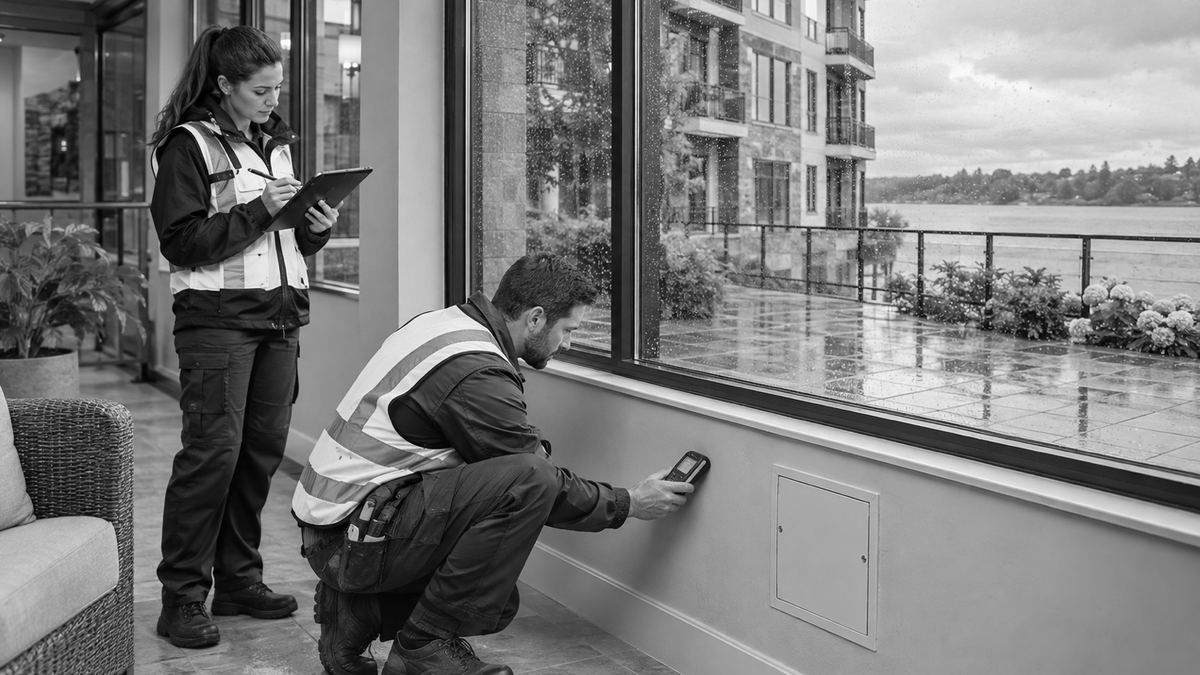
Waterfront properties face wind-driven rain, humid air, and flood pathways, so trained teams need a calm moisture-check routine after every water event.
Buildings beside oceans, lakes, rivers, and canals can experience moisture from several directions at once. Rain can enter around windows, doors, roof edges, wall penetrations, and damaged flashing. High outdoor humidity can contribute to condensation on cold surfaces. Rising water, storm surge, river flooding, drainage backups, and saturated soil can affect lower levels, crawlspaces, elevator pits, utility rooms, and stored materials.
A waterfront moisture routine should help property managers and maintenance teams move from observation to source control, drying, documentation, and follow-up. It should not encourage employees to enter a structurally unsafe, electrically hazardous, sewage-contaminated, or otherwise uncontrolled area. After a major event, the first decision may be to restrict access and wait for qualified safety, utility, building, environmental, or remediation professionals.
Why Waterfront Properties Need a Different Moisture Check
Wind-driven rain does not behave like a simple roof drip. Water may move upward, sideways, or behind cladding under pressure. It can enter through small failures that stay dry during ordinary rain. The visible stain may appear far from the entry point after water follows framing, insulation, masonry, or utility pathways.
Waterfront buildings also experience frequent transitions between warm humid air and cooled indoor surfaces. Condensation can form on supply diffusers, chilled-water lines, cold masonry, metal framing, glazing, and surfaces near exterior doors. Salt spray can accelerate corrosion of fasteners, equipment, and enclosures, which may create new leakage paths or complicate repairs. Property teams should document the condition without assuming that every stain has the same source.
Lower levels deserve special planning. Basements, crawlspaces, garages, pits, storage rooms, and mechanical spaces may receive seepage or backup before occupied areas show a problem. These areas can contain electrical equipment, fuel systems, chemicals, sharp debris, contaminated water, or limited access. A mold-awareness course does not authorize entry into those hazards.
Build a Post-Event Inspection Route
Start with a map that groups spaces by likely water pathway. Exterior zones can include roof edges, drains, scuppers, parapets, wall joints, windows, doors, louvers, balconies, deck connections, and penetrations. Interior zones can include top-floor ceilings, perimeter walls, window sills, mechanical rooms, stair towers, shafts, lower levels, utility chases, and storage against exterior walls.
Assign inspection routes by role. Security or front-desk staff may report visible water and restrict access. Maintenance staff may inspect accessible building components within their qualifications. Managers may coordinate residents, tenants, vendors, insurers, and records. Roof access, electrical evaluation, structural assessment, confined-space work, and contaminated-water cleanup should remain with people qualified and authorized for those tasks.
Use repeatable photo locations and simple location names. Record the building, floor, room, wall orientation, nearby equipment, date, time, weather event, and observed condition. A close-up of wet drywall is less useful when no one can tell which wall or window it belongs to. Pair detail photos with a wider view and note whether the area changed after the first check.
Check the Building Envelope and Interior Together
Exterior and interior observations should be connected. If water appears below a window, document seals, flashing, drainage paths, adjacent facade joints, and interior finishes. If a ceiling tile is wet, consider roof drainage, rooftop equipment, plumbing, condensation, and wind direction instead of assigning a cause from the stain alone.
Inspect accessible wall and floor transitions where water can hide. Baseboards, carpet edges, resilient flooring seams, cabinets, gypsum board, insulation, and stored cardboard can retain moisture after the surface looks dry. Do not open walls or disturb suspect mold growth without an appropriate plan. A moisture meter can support an inspection when the user understands the instrument and material, but one reading is not a universal pass or fail result.
HVAC operation should be part of the review. A power outage, flooded equipment, damaged ductwork, blocked condensate drain, or disabled dehumidification can change indoor humidity quickly. Do not restart flooded or questionable electrical or HVAC equipment until qualified personnel determine that it is safe. After service is restored, monitor conditions and check whether condensate is draining and air is reaching the intended spaces.
Respond to Floodwater With a Safety Boundary
Floodwater may contain sewage, chemicals, sharp objects, or other contaminants. It can conceal damaged floors and energized equipment. Staff should not enter standing water or begin cleanup simply because the water level is falling. Establish who can evaluate structural, electrical, utility, and contamination hazards before general access resumes.
Once the area is safe to enter, document the water line, affected materials, contents, odors, visible growth, and equipment condition. Separate items that can be evaluated from materials that are clearly damaged. Do not move wet porous contents into clean occupied areas or place them against dry walls. Use the property procedure for containment, disposal, cleaning, and insurance documentation.
EPA and CDC guidance emphasizes moisture control and prompt drying. The practical goal is to remove water, correct the source, dry materials that can be safely retained, and remove materials that cannot be adequately cleaned or dried. Large, contaminated, or complex losses may require professional remediation and environmental or industrial hygiene support.
Common Mistakes and Misconceptions
One mistake is treating a waterfront building as permanently damp and accepting recurring stains or odors as normal. The climate may make moisture control more demanding, but repeated wetting still deserves a source investigation and documented response.
Another mistake is painting over a water stain before the source and material condition are addressed. New paint can hide evidence without correcting a leak, wet insulation, damaged gypsum board, or condensation pattern. Repair and drying verification should come before cosmetic closeout.
Teams also assume that a dry surface means the assembly is dry. Water can remain behind finishes, beneath flooring, inside insulation, or in stored materials. Follow-up observations and appropriate instruments can help, but staff should understand their limits and escalate when hidden damage is suspected.
A fourth mistake is using one indoor humidity reading as a federal mold threshold. EPA, OSHA, and CDC do not set a universal numerical indoor mold limit that declares every building safe or unsafe. Humidity readings provide context; they do not replace inspection, source control, or professional judgment.
Finally, avoid spraying chemicals as a substitute for moisture correction. Products can create exposure or material-compatibility concerns, and mixing cleaners can be dangerous. Follow label directions, employer procedures, and professional guidance. The priority is to control the water source and address affected materials safely.
How Training Helps
Training gives property teams a shared vocabulary for leaks, condensation, flooding, material damage, documentation, and escalation. It can help a front-desk employee report the right location, a maintenance technician record conditions consistently, and a manager understand why the work order should remain open until the source and drying are addressed.
The Mold Prevention and Remediation Awareness Training course at moldtraining.us is a natural fit for waterfront property staff who need foundational knowledge about moisture control, mold awareness, prevention, and response boundaries. Property Management Mold Training may also help managers who coordinate occupants, work orders, vendors, and records across a portfolio.
Courses provide certificates of completion and do not guarantee licensure or authorize regulated inspection, assessment, or remediation work. Requirements vary, so employers and learners should check current state and local rules before offering services or assigning duties. Course learning should be supplemented with site-specific emergency plans, equipment procedures, vendor contacts, and hands-on instruction where the job requires it.
If your team manages a waterfront building, consider pairing a course with a walk-through of the actual roof drainage, facade, HVAC, lower-level, and reporting systems. The goal is a practical routine that employees can use without exceeding their role.
Frequently Asked Questions
Should staff inspect immediately after every storm?
Use a risk-based schedule tied to the building and event. Staff should not enter areas with structural, electrical, floodwater, severe-weather, or access hazards. Once conditions are safe, priority checks can focus on known weak points, lower levels, roof drainage, perimeter rooms, and equipment. More detailed follow-up may be needed after wind-driven rain, flooding, a power outage, or a reported leak.
Does a musty odor prove there is mold behind a wall?
An odor is a reason to investigate moisture and building conditions, but it does not by itself locate the source or identify what is present. Document where and when it occurs, check accessible moisture sources, and escalate hidden or recurring conditions to qualified professionals rather than opening materials without a plan.
Should a property test the air after every water event?
Routine air sampling is not automatically the best first step. EPA and CDC guidance generally emphasizes visual inspection, moisture correction, and addressing affected materials. A qualified professional may recommend sampling for a specific question, but testing should not delay source control or necessary drying.
Can maintenance staff restart HVAC equipment after flooding?
Flooded or questionable HVAC and electrical equipment should be evaluated by qualified personnel before restart. Operating contaminated or damaged equipment can spread contaminants or create safety hazards. The property plan should name who has authority to inspect, clean, repair, and release the system.
What should the moisture event record include?
Record the location, date, time, weather or water event, suspected source, affected materials, photos, access restrictions, work orders, vendors, drying steps, readings with instrument details when used, disposal, communications, and follow-up. Keep facts separate from unverified conclusions.
When should a waterfront property call a specialist?
Seek qualified help when water is contaminated, damage is extensive, structural or electrical safety is uncertain, occupants may be especially vulnerable, HVAC systems are involved, mold growth is widespread or hidden, or the source and drying cannot be confirmed within the team's capability.
Conclusion
Waterfront properties need more than a generic leak checklist. Their moisture plan should connect wind-driven rain, humidity, flood pathways, exterior assemblies, lower levels, HVAC, occupants, and vendor decisions. A repeatable route and clear safety boundaries help teams respond consistently without guessing.
Training supports early recognition and better records, but the property procedure determines what happens next. Inspect when access is safe, correct the water source, document affected materials, verify follow-up, and involve qualified professionals when conditions exceed the team's role. That steady process protects building materials and supports healthier indoor environments without making promises that a course or checklist cannot deliver.
Sources
U.S. Environmental Protection Agency, Mold Remediation in Schools and Commercial Buildings - https://www.epa.gov/mold/mold-remediation-schools-and-commercial-buildings-guide
U.S. Environmental Protection Agency, Mold Remediation Guide Appendix B - https://www.epa.gov/mold/mold-remediation-schools-and-commercial-buildings-guide-appendix-b
Centers for Disease Control and Prevention, Mold, Testing, and Remediation - https://www.cdc.gov/niosh/mold/testing-remediation/index.html
Centers for Disease Control and Prevention, Returning Home After a Natural Disaster - https://www.cdc.gov/natural-disasters/safety/returning-home-after-natural-disaster.html
Mold Training, Mold Prevention and Remediation Awareness Training - https://moldtraining.us/mold-awareness-training/