
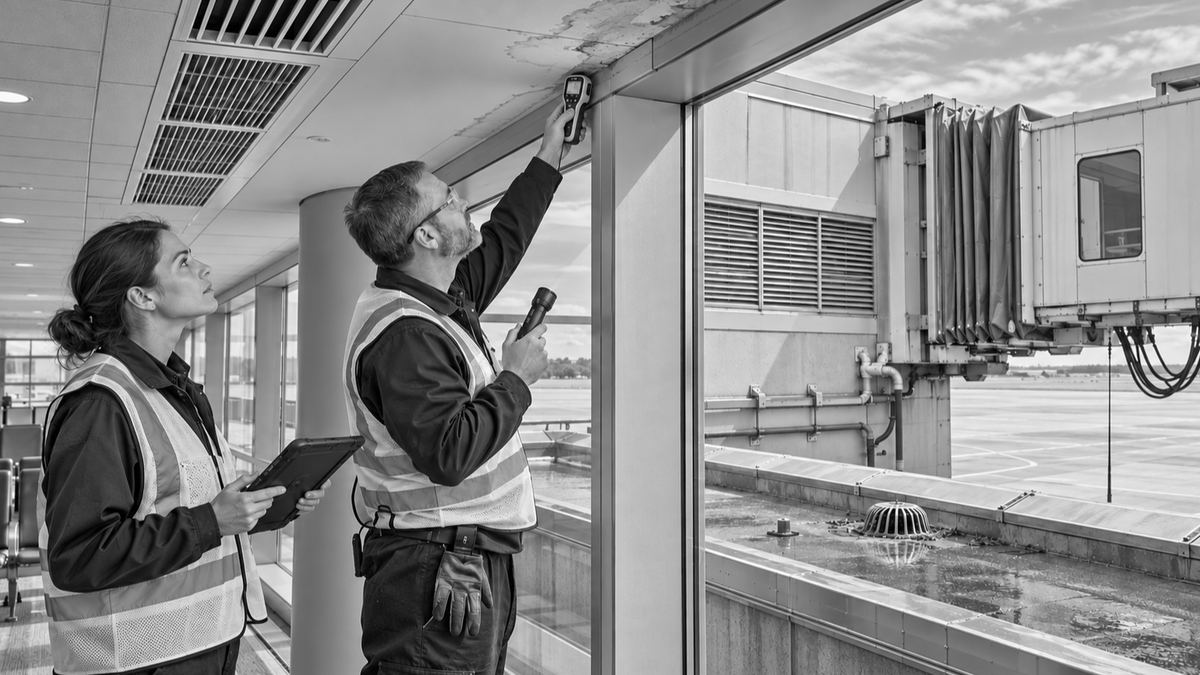
Airport facilities can develop hidden moisture problems where roofs, jet bridges, HVAC systems, plumbing, and around-the-clock operations meet. A small leak near a gate can affect ceiling materials, wall cavities, carpet, equipment, or occupied areas before the source is obvious. Training helps facilities teams recognize water conditions early, document neutral observations, control access, coordinate repairs, and verify drying without asking general staff to diagnose mold or perform work beyond their role.
Airports combine large roof areas, complex envelopes, long terminal facades, moving bridge connections, mechanical systems, food service, restrooms, baggage areas, offices, and secure operations. Different organizations may own or maintain adjacent components. A useful moisture response process therefore needs clear locations, handoffs, safety boundaries, and closure evidence.
Where Airport Moisture Problems Begin
Roof systems are an obvious starting point, but the pathway may be indirect. Water can enter at membranes, seams, drains, flashings, curbs, skylights, penetrations, or transitions between older and newer construction. It may travel along decking or structural members before appearing at a ceiling tile. Staff should record the first observed location and conditions without assuming it is directly below the source.
Jet bridge connections create moving and weather-exposed transitions. Seals, canopies, wall interfaces, floor joints, drainage features, and service penetrations can be affected by wind-driven rain, snow, ice, condensation, wear, or alignment problems. The bridge itself may be maintained by a different team from the terminal wall. Work orders should identify the exact gate and component and route the report to the responsible group while preserving shared visibility.
HVAC systems can introduce or spread moisture when condensate pans, drains, coils, insulation, filters, ductwork, controls, or humidity management do not function as intended. Terminals also experience changing door cycles, passenger loads, outdoor air, equipment heat, and operating schedules. A wet ceiling near a diffuser may involve roof water, condensate, plumbing, or another source. Staff should document the evidence and involve qualified HVAC or building-envelope personnel as appropriate.
Plumbing and food-service areas add recurring risk. Restrooms, concessions, janitor closets, ice machines, dish areas, water fountains, and service corridors can produce leaks or repeated wetting. Baggage systems and secure rooms may make access difficult. A response plan should identify who can enter each area, who controls equipment, and how affected materials will be inspected without disrupting safety or security controls.
Building a Practical Moisture Check Route
Start with known history. Map recurring leak points, repaired roof areas, bridge connections, condensate issues, plumbing failures, facade joints, low roof sections, and rooms that have generated odor or staining reports. Include dates, weather, repairs, and recurrence. A route based on actual history is more useful than a generic walk that gives every area equal attention.
Use both scheduled and event-driven checks. Scheduled rounds can include roof drains, ceilings, exterior wall transitions, mechanical rooms, condensate systems, restrooms, concessions, and below-grade areas. Event-driven checks can follow heavy rain, wind-driven rain, snowmelt, freeze-thaw cycles, plumbing repairs, HVAC shutdowns, construction, or a reported odor. Staff should not enter roofs, electrical areas, restricted zones, or structurally questionable areas without authorization and appropriate controls.
Record exact locations in airport terms that other teams can find. Include terminal, concourse, level, gate, room, column line, asset number, nearby tenant, and side of the space where relevant. A note that says ceiling leak at airport is unusable. A stable location supports facilities dispatch, tenant coordination, security access, and follow-up after the visible sign is gone.
Document observations neutrally. Note active dripping, damp materials, staining, bubbling paint, loose flooring, condensation, musty odor reports, damaged insulation, standing water, or visible discoloration. Record date, time, weather, photographs according to policy, affected materials, approximate area, immediate controls, and people notified. Do not label a substance as mold unless it has been appropriately evaluated.
Control the immediate condition. Keep people away from slip, electrical, falling-material, or other hazards. Protect unaffected materials when it can be done safely. Stop or contain the water source within authorized procedures and coordinate with operations, tenants, security, airlines, concessionaires, and contractors as needed. Emergency safety and operational decisions come before routine documentation.
Follow the moisture path. Qualified personnel may need to inspect above ceilings, behind finishes, around windows, under flooring, inside equipment, or at exterior transitions. Hidden areas deserve attention because surface drying can conceal wet insulation, gypsum material, carpet backing, or wall cavities. The scope should reflect the event and building assembly rather than an arbitrary inspection radius.
Verify drying and repair. Record the method, equipment, readings or observations used by qualified personnel, removed materials, repairs, and follow-up date. A replaced ceiling tile does not prove the roof, insulation, or cavity is dry. Close the record only when the source, affected materials, drying, repair, and recurrence check are addressed within the organization's process.
Common Mistakes and Misconceptions
One mistake is replacing stained finishes before finding the water source. Fresh paint or a new ceiling tile may improve appearance while the leak continues above it. Treat the visible damage as evidence that requires source and moisture review.
Another mistake is assuming every gate-area leak belongs to one department. Terminal envelope, jet bridge, airline equipment, tenant work, and roof drainage responsibilities may overlap. Use a shared record and clearly assigned lead so ownership questions do not delay protection and investigation.
Do not wait for visible growth before responding. Moisture control is the central prevention step. Wet materials, recurring condensation, standing water, and musty odors deserve timely attention even when visible growth is not present.
Avoid universal federal mold thresholds. There is no single federal airborne mold concentration or surface level that automatically determines whether every building is safe. Decisions should consider the moisture source, affected materials, extent, occupants, work activities, applicable guidance, and qualified evaluation.
Do not assume that an air sample replaces a moisture investigation. Sampling may be appropriate in some situations, but a number without building context may not identify the water source or define the repair. Property teams should begin with safe documentation, moisture control, and qualified escalation.
Another misconception is that a training certificate authorizes every type of inspection or remediation. Training can build awareness and operational consistency, but job assignments must match the employee's competence, employer procedures, equipment, hazards, and state or local requirements.
How Training Helps
Training helps frontline staff recognize early warning signs and report them in consistent language. Custodial teams, gate staff, tenant coordinators, security personnel, and maintenance dispatchers may notice a condition before a building engineer arrives. They need a simple reporting path, location fields, urgent hazard criteria, and instructions not to disturb questionable materials.
Facilities technicians need deeper practice in routing, documentation, source categories, moisture checks, containment boundaries, PPE decisions, vendor handoff, and closure. Scenario-based exercises can use a gate leak after wind-driven rain, a blocked condensate drain above a public area, or recurring restroom moisture beside a tenant wall. Participants should identify immediate controls, responsible teams, records, escalation points, and follow-up evidence.
Supervisors should train for coordination. A moisture event may involve airport operations, airline representatives, concession tenants, roof contractors, HVAC technicians, industrial hygiene professionals, remediation contractors, risk management, and communications staff. The supervisor needs a clear lead, shared location, decision log, access plan, and update schedule.
The Property Management Mold Training course from moldtraining.us is a natural fit for property managers, maintenance and facilities staff, leasing or tenant-facing teams, and building superintendents who coordinate moisture reports, vendors, documentation, and follow-up. It provides a certificate of completion after the final exam. The certificate does not guarantee licensure or replace employer qualification, and participants should review state and local requirements for regulated inspection, assessment, sampling, or remediation work.
Airport organizations can use the course as a foundation and add site-specific modules covering secure access, terminal and bridge ownership, roof safety, work orders, tenant coordination, emergency contacts, approved instruments, PPE, and vendor procedures. A soft rollout can begin with supervisors and dispatch staff, then expand to technicians and frontline reporters based on role.
Frequently Asked Questions
What should staff do first when they find a wet ceiling near a gate?
Protect people from immediate hazards, report the exact location, and follow the airport's emergency and facilities procedures. Note active water, electrical concerns, loose materials, weather, and affected operations. Do not remove ceiling materials or enter restricted areas unless authorized and trained. Facilities staff can then coordinate source investigation and drying.
Does a stained ceiling tile prove there is mold?
No. Staining shows that a material has been affected, but appearance alone does not identify the substance or current moisture condition. Record the observation neutrally, investigate the water source, assess surrounding materials, and involve qualified personnel when the situation exceeds the property team's role.
How quickly should wet materials be addressed?
EPA guidance emphasizes prompt water removal and drying, commonly within 24 to 48 hours when practical and safe. The correct response depends on the material, contamination, extent, access, safety, and applicable procedures. Do not delay source control while waiting for visible growth.
Should every airport moisture event be sampled for mold?
Not necessarily. Sampling decisions should be based on the purpose, building conditions, affected materials, occupants, applicable requirements, and qualified judgment. Many events first require source control, visual and moisture assessment, drying, removal decisions, and documentation. A test should answer a defined question rather than substitute for investigation.
Can airport maintenance staff perform remediation after training?
Training alone does not decide the scope an employee may perform. The employer should consider hazards, extent, materials, PPE, containment, procedures, competence, and state or local rules. Larger, complex, contaminated, or occupant-sensitive conditions may require specialized contractors or professionals.
How can teams prevent repeat leaks at the same gate?
Keep one location-based history linking weather, bridge position, inspections, repairs, photographs, affected materials, drying verification, and recurrence checks. Review patterns after similar weather and confirm responsibility for terminal, bridge, roof, and seal components. A repeated symptom should trigger a broader source review rather than another cosmetic repair.
Conclusion
Airport moisture prevention depends on fast recognition, exact location records, safe source control, coordinated access, verified drying, and follow-up across organizational boundaries. Roofs, jet bridges, HVAC systems, plumbing, concessions, and terminal finishes should be treated as connected parts of the building rather than isolated work orders.
Training gives property and facilities teams a shared process for noticing, documenting, escalating, and closing moisture events. It does not turn every employee into an inspector or guarantee a regulatory credential. Pair a relevant course with airport-specific procedures and state or local requirements so each person knows what to do, what not to do, and when to involve qualified help.
Sources
U.S. Environmental Protection Agency, Moisture Control Guidance for Building Design, Construction and Maintenance | https://www.epa.gov/indoor-air-quality-iaq/moisture-control-guidance-building-design-construction-and-maintenance-0
U.S. Environmental Protection Agency, Mold Course Chapter 9 | https://www.epa.gov/mold/mold-course-chapter-9
moldtraining.us, Property Management Mold Training | https://moldtraining.us/mold-training-for-property-management/
moldtraining.us, State Mold Training Requirements | https://moldtraining.us/state-mold-training-requirements/