
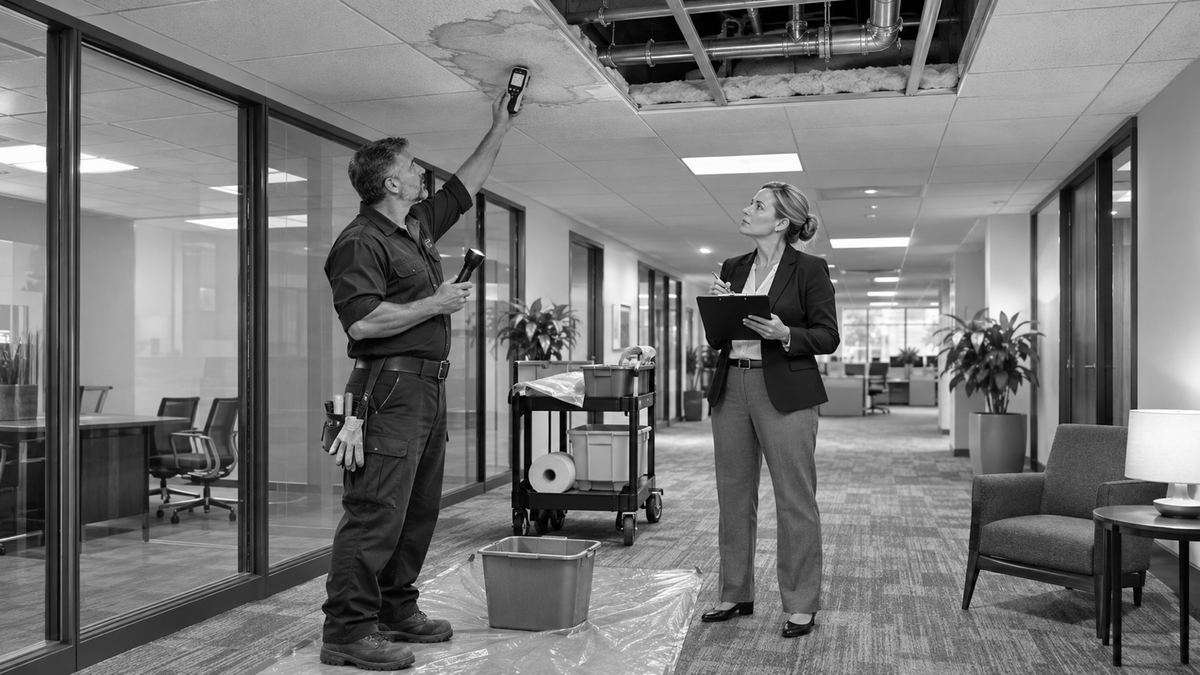
Office leak response works best when property teams trace the water path, protect occupants, dry affected materials, and verify conditions before closing. A stained ceiling tile may be the first visible clue, but water can move above ceilings, along pipes, inside wall cavities, under flooring, and through insulation. Training helps maintenance and property staff organize the response without assuming that the visible stain defines the full affected area.
This article offers practical education, not a diagnosis, remediation specification, or legal opinion. Building conditions and state or local requirements vary. When damage is extensive, hidden, contaminated, or beyond staff capability, engage qualified professionals and follow applicable requirements.
Start With the Source and the Water Path
The first priority is to stop or control the source when it can be done safely. Office leaks may come from domestic plumbing, roof drainage, HVAC condensate, sprinkler piping, restroom fixtures, appliances, exterior walls, or work in a neighboring suite. The response record should identify what was observed, who was notified, when water was isolated, and whether a plumber, roofer, HVAC technician, or other specialist is needed.
Do not assume the point where water appears is directly below the source. Water can travel along a pipe, beam, cable, deck flute, or sloped surface before it drips. Inspect the area above and around the first sign while observing electrical and access hazards. A simple sketch can mark the source, visible wet materials, suspected travel paths, and rooms above or beside the affected space.
Classify the operational situation before disturbing materials. A clean-water plumbing leak calls for different precautions than a drain backup, floodwater intrusion, or water that contacted contaminants. Staff should know when company procedures require escalation, restricted access, personal protective equipment, or specialized cleanup. Training should emphasize that uncertainty is a reason to pause and obtain qualified help.
Protect People and Office Operations
Leaks in occupied offices require communication as well as drying. Establish a safe boundary around falling ceiling material, slippery flooring, exposed wiring, or active dripping. Coordinate with tenants, department leaders, security, and cleaning staff so people do not enter the area or move wet materials without direction. Relocation may be appropriate while the source and damage are evaluated.
Record affected rooms, workstations, stored materials, ceiling areas, and floor finishes. Photographs may support the record when privacy and company policy permit. Protect confidential papers and electronic equipment without moving them through wet or contaminated areas unnecessarily. The property team should also document business interruptions and access constraints that could affect the response schedule.
Occupant reports can help locate hidden moisture, but odor or symptoms alone do not identify the source or extent. Listen carefully, document the concern, and avoid making medical conclusions. Direct health questions to appropriate healthcare professionals and building-condition questions to qualified assessors when needed. Clear updates about what was found, what is being done, and when the area will be rechecked can reduce confusion.
Inspect Materials, Not Just Surfaces
Office assemblies combine porous and nonporous materials. Ceiling tile, gypsum board, insulation, carpet cushion, composite furniture, paper, and acoustic products can retain water differently from metal, glass, or sealed hard surfaces. Inspectors should consider both sides of materials when accessible and safe. A dry-looking painted surface does not prove the cavity behind it is dry.
Moisture meters, infrared cameras, humidity instruments, and visual inspection can support the investigation when users understand their limits. A meter reading should be compared with an appropriate dry reference and interpreted for the material. Infrared images show temperature patterns, not mold and not moisture by themselves. Instruments should guide verification, not replace source tracing and physical inspection.
Create a moisture map with repeatable locations. Mark room, wall, ceiling grid, floor area, material, time, instrument, reading, and comparison point. Recheck the same locations as drying proceeds. The trend matters: areas should move toward normal reference conditions while the source remains controlled. If readings stall or rise, investigate airflow, hidden reservoirs, or continuing leakage.
Drying and Removal Decisions
EPA guidance emphasizes moisture control and prompt drying of wet materials, commonly within 24 to 48 hours when feasible. That timeframe is a response goal, not a guarantee that growth will or will not occur. Material condition, water source, temperature, humidity, duration, and hidden wetness all influence decisions. Teams should act quickly while documenting when the leak began, when it was discovered, and when drying started.
Remove standing water with methods suitable for the situation. Open assemblies only when staff are trained and the work can be performed safely. Direct drying air so it reaches affected surfaces without spreading contaminants. Dehumidification may help control humidity, but equipment selection and placement should reflect the size of the area, building HVAC operation, electrical capacity, and occupancy.
Some wet porous materials may be difficult to clean and dry reliably. Ceiling tiles that are saturated, deformed, or stained may need replacement after the source is corrected. Gypsum board, insulation, and carpet systems require evaluation based on condition and project guidance. Do not paint, seal, or close wet materials merely to restore appearance. Concealing moisture can delay discovery of a continuing problem.
Common Mistakes and Misconceptions
One mistake is replacing the stained tile immediately and considering the leak closed. The source, surrounding materials, and space above the grid still need inspection. Another is aiming a fan at the visible spot without checking where the water traveled. Drying equipment is most useful after the affected area is mapped and unsafe or contaminated conditions are addressed.
A common misconception is that a single air sample can prove an office is safe or compliant. EPA notes that no federal limits have been set for mold or mold spores, and visible growth often does not require sampling to begin a moisture response. Sampling decisions should be made by experienced professionals for a defined purpose, not used as a substitute for correcting water problems.
Another mistake is closing the ceiling as soon as the surface feels dry. Verification should include the affected materials and dry comparison areas, with records showing that conditions returned toward normal. Before replacement, confirm the source repair held, the cavity is clean as required, and no wet insulation or stored material remains above the ceiling.
How Training Helps
Mold awareness and prevention training gives property managers, maintenance technicians, building engineers, and cleaning supervisors a shared response vocabulary. Staff can practice source control, moisture mapping, documentation, occupant communication, and escalation. Training also helps them understand tool limitations and avoid claims that a meter, odor, or sample alone proves the condition of an entire building.
The Mold Prevention, Assessment, and Remediation course available through moldtraining.us can support teams that need a structured overview of moisture control, recognition, assessment concepts, and response planning. A course should be paired with building-specific procedures, emergency contacts, equipment instructions, and hands-on practice for the tools employees actually use.
Courses provide certificates of completion, but a certificate does not guarantee licensure or authorize work beyond applicable rules. Mold licensing and remediation requirements vary by state and locality. Employers and individuals should review current state and local requirements and define roles accordingly before offering regulated services or performing work that may require a license.
Frequently Asked Questions
How quickly should an office leak be addressed?
Begin source control, safety measures, and moisture evaluation as soon as practical. EPA commonly advises drying wet materials within 24 to 48 hours when feasible. Treat that as a prompt-action goal while considering the water source, materials, hidden spaces, and actual start time.
Does a ceiling stain prove mold is present?
No. A stain shows that moisture or another condition affected the material, but it does not identify mold or the full water path. Inspect the source, surrounding materials, and hidden spaces. Visible growth, persistent odor, repeated wetting, or extensive damage may justify qualified professional evaluation.
Should staff use an infrared camera?
An infrared camera can help identify temperature patterns that deserve follow-up, especially across a large ceiling or wall. It does not see mold and cannot confirm moisture without supporting inspection or measurements. Users need training in reflections, thermal bridging, HVAC effects, and other causes of temperature differences.
Can the office remain occupied during drying?
That depends on the source, hazards, extent, equipment, noise, access, and work methods. Property teams should follow their procedures and obtain qualified advice when the situation is extensive or uncertain. Keep people away from falling materials, electrical hazards, slippery surfaces, and any controlled work area.
When can ceiling tiles be replaced?
Replace finishes after the source is repaired, affected areas have been inspected, retained materials have reached appropriate dry conditions, and required cleaning or removal is complete. Record the verification. A new tile should be the final restoration step, not the first response.
Is mold training the same as a state license?
No. Training can provide knowledge and a certificate of completion, but it does not guarantee licensure. Requirements vary. Check state and local rules for assessment, remediation, contracting, and other regulated activities before deciding who may perform the work.
Conclusion
An office ceiling leak is a building-system event, not merely a cosmetic stain. Property teams should trace the source and water path, protect occupants, map affected materials, dry or remove them appropriately, verify conditions, and document closure. A trained team can move faster without skipping the evidence needed for a durable repair.
Sources
United States Environmental Protection Agency, An Office Building Occupant's Guide to Indoor Air Quality: https://www.epa.gov/indoor-air-quality-iaq/office-building-occupants-guide-indoor-air-quality
United States Environmental Protection Agency, A Brief Guide to Mold, Moisture and Your Home: https://www.epa.gov/mold/brief-guide-mold-moisture-and-your-home
Centers for Disease Control and Prevention, Mold: https://www.cdc.gov/mold-health/about/index.html