
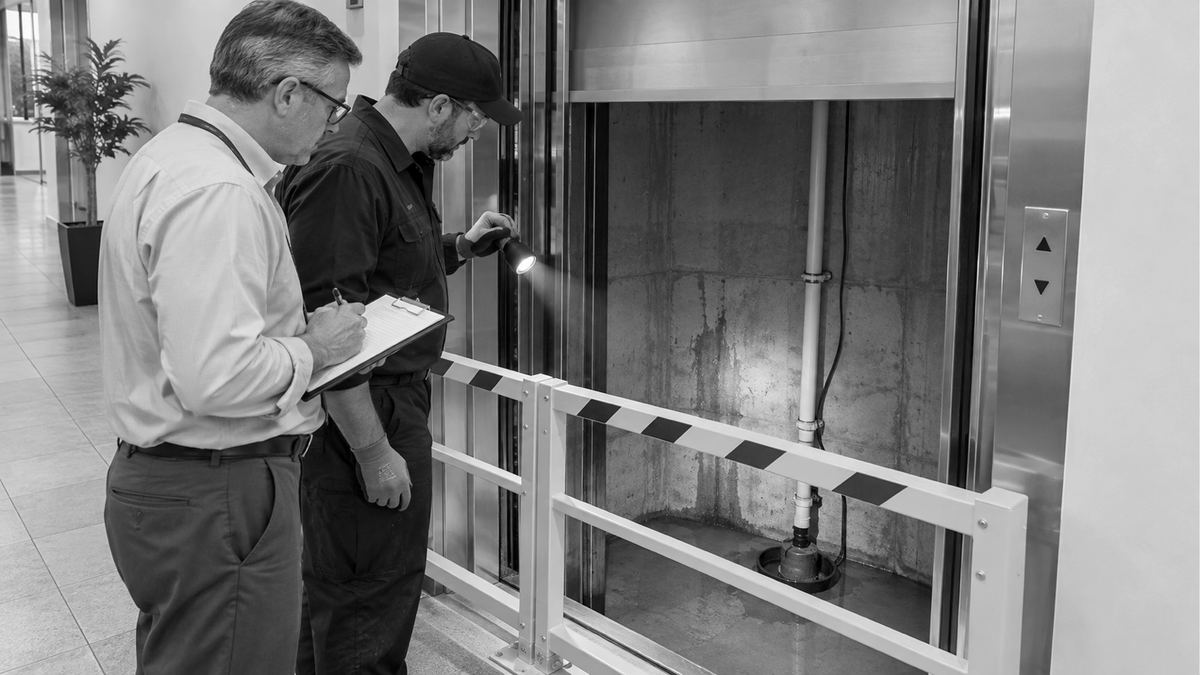
Elevator pits can collect seepage, leaks, and condensation out of sight, so property teams need a safe process to report moisture before damage spreads.
An elevator pit is a specialized service area at the bottom of a hoistway, not a routine maintenance room. Water may appear after heavy rain, a failed sump, a plumbing event, groundwater seepage, fire-suppression discharge, or condensation on cold surfaces. Because the area is below the lowest landing and normally out of view, dampness can persist before occupants or property staff notice it.
Property teams play an important role in early recognition, but they should not enter, operate, or disturb elevator equipment unless they are authorized, qualified, and following all applicable safety requirements. A practical moisture process coordinates building management, maintenance, elevator professionals, plumbers, waterproofing contractors, environmental support, and other specialists without blurring those boundaries.
The objective is to find and correct the moisture source, protect people, document affected materials, and verify follow-up. A water stain does not identify mold, and a musty odor does not establish a species or exposure level. Staff should record what they can safely observe and escalate the condition rather than making conclusions outside their role.
Why Elevator Pit Moisture Needs a Specific Plan
Elevator pits combine several conditions that make ordinary leak response difficult. They are low points where water can collect, access is restricted, visibility may be limited, and important electrical or mechanical equipment may be nearby. The hoistway can also connect multiple floors, which makes unplanned air movement, service disruption, and communication especially important.
Moisture may affect concrete walls and floors, coatings, joint sealants, stored debris, wood left from construction, insulation, wall materials near the landing, or adjacent rooms. The pit itself may contain mostly nonporous surfaces, but water can migrate beyond it or keep nearby porous materials damp. Hidden areas deserve attention when staining, odor, or recurring water suggests the visible area is not the entire problem.
The source may be intermittent. A sump can appear functional during a dry inspection and fail during a storm. A wall joint may seep only when groundwater rises. Condensation may form during seasonal temperature and humidity changes. A plumbing release may stop before staff arrive while leaving wet materials behind. Records across events help the team distinguish a one-time spill from a recurring building condition.
Safety comes before investigation. An open elevator landing, energized equipment, unexpected car movement, fall exposure, confined-space questions, contaminated water, and slippery surfaces can require controls beyond mold awareness. Property staff should secure the area and contact the appropriate elevator and safety professionals according to the building's procedures.
What Property and Maintenance Teams Should Check
Begin with reports that do not require pit entry. Note the date, time, elevator identifier, floor, weather, recent plumbing or fire-suppression events, odors, visible staining, standing water seen from an authorized safe position, and whether the elevator is operating. Avoid opening doors, defeating interlocks, or entering the hoistway to obtain a better photo.
Review the sump and drainage history with qualified personnel. Records should show pump service, alarm events, discharge concerns, backup power or contingency arrangements when applicable, and prior water levels. A pump can remove water without correcting the entry path, so repeated cycling deserves investigation.
Look beyond the pit. Check nearby mechanical rooms, plumbing chases, roof drains, exterior walls, floor drains, and spaces sharing the same wall or slab. A leak can travel along joints, conduits, or penetrations before appearing at the low point. Map observations instead of assuming the nearest stain identifies the source.
Coordinate inspection of wall joints, penetrations, cracks, coatings, and previous repairs. A fresh patch may hide the history if no one records the date, product, location, and reason. Photos from the same safe viewpoint can help compare changes over time. Include a scale or fixed reference when practical, but do not place objects inside the hoistway merely for documentation.
Document affected materials and duration. Concrete can remain visibly damp without supporting the same type of growth as paper-faced gypsum, wood, dust, or other organic material, but contamination and deterioration can still occur. Identify debris or porous items that should not be stored in the pit. Qualified professionals should determine appropriate cleaning, drying, removal, or remediation methods.
Review water category and source. Clean rainwater, sewage, groundwater, fire-suppression water, and process water can require different precautions and response. Staff should not assume water is clean based only on appearance. When the source is uncertain or contamination is possible, escalate to qualified support.
Check communication and service decisions. Building management should know who can take an elevator out of service, how occupants are notified, how accessibility needs are addressed, and who authorizes return to service. Moisture response should not create an improvised elevator decision by an employee without authority.
Plan follow-up after the visible water is removed. Record how the source was corrected, what materials were dried or removed, whether moisture remained in adjacent areas, who verified the condition, and what monitoring will occur after the next rain or equipment cycle. A closed work order should reflect evidence, not simply that a pump ran.
Common Mistakes and Misconceptions
One misconception is that concrete and steel mean there is no mold concern. Even where structural surfaces are nonporous, dust, coatings, joint materials, debris, insulation, or nearby wall systems can remain damp. The broader moisture condition matters more than a quick look at one surface.
Another mistake is sending general maintenance staff into the pit because the water appears shallow. Elevator pits have hazards unrelated to water depth. Access and work should be handled by authorized and qualified personnel under the applicable procedures.
It is also a mistake to treat a sump pump as the repair. Pumping may control accumulation, but the team still needs to identify why water entered, whether the discharge path is appropriate, whether the pump is reliable, and whether materials remained wet long enough to require additional evaluation.
Do not diagnose mold by color or odor. Dark staining can have several causes, and an odor does not identify species or amount. Record the observation, correct moisture, and obtain qualified evaluation when the condition, extent, health concerns, or local requirements warrant it.
A further mistake is closing the work order after a dry-weather visit. If the condition appears during storms or seasonal humidity, schedule verification under the conditions that trigger it. Repeated photos, pump records, and weather notes can reveal patterns that a single inspection misses.
Finally, do not spray bleach, fragrance, or another product into the pit as a general response. Product use can create chemical, equipment, ventilation, and exposure concerns while leaving the moisture source unresolved. Cleaning and remediation methods should follow qualified guidance and equipment restrictions.
How Training Helps
Mold awareness training can help property staff understand moisture control, common building sources, observation limits, documentation, communication, and escalation. It can also help teams avoid claims that a stain, odor, or air sample proves more than it does.
The Mold Awareness Training course at moldtraining.us is a natural fit for property managers, front-desk staff, maintenance coordinators, and employees who may receive the first report but do not perform inspections or remediation. The Property Management Mold Training course can support managers and maintenance teams who coordinate leaks, work orders, vendors, resident or occupant communication, and follow-up across a portfolio.
Organizations should add site-specific instruction covering elevator contacts, restricted-access rules, emergency procedures, work-order fields, water-response vendors, and the authority to remove an elevator from service. Mold training does not replace elevator, electrical, fall-protection, confined-space, or hazardous-material training that may apply to the task.
Courses provide certificates of completion. A certificate documents course completion, but it does not guarantee licensure, authorize elevator work, or by itself qualify someone to inspect or remediate mold. Learners and employers should review state and local requirements for mold services, elevator work, and any other regulated activity.
A short tabletop exercise can make the procedure useful. Present a scenario involving water visible after a storm, a musty odor near the lowest landing, or a failed sump alarm. Ask staff to secure the area, identify the contacts, describe safe observations, create the work order, plan follow-up, and explain what evidence would support closure.
Frequently Asked Questions
Can property staff enter an elevator pit to check for mold?
Not simply because they work in building maintenance. Elevator pits can present fall, movement, electrical, access, and other hazards. Entry and inspection should follow the building's elevator and safety procedures and be performed only by people with the necessary authorization, qualifications, and controls.
Does standing water in a pit always mean there is mold?
No. Standing water shows a moisture problem that needs prompt attention, but it does not establish mold growth, type, amount, or exposure. Correct the source, assess affected materials, and use qualified evaluation where appropriate.
Is a working sump pump enough to prevent moisture problems?
No. A working pump may reduce water accumulation, but seepage, leaks, condensation, pump cycling, discharge routing, and wet adjacent materials still need review. The source and recurrence pattern should be documented.
Should the elevator stay in service during a moisture event?
That decision depends on the water location, equipment condition, electrical and mechanical concerns, access, applicable procedures, and qualified elevator guidance. Property staff should use established contacts and authority instead of making an unsupported assurance.
Can an air sample prove the pit is safe?
No single air sample proves that an elevator pit or adjacent building area is safe. Sampling has limitations and should be used only when it answers a defined question within a qualified assessment. Moisture-source correction and careful visual documentation are usually the first priorities.
When should outside mold or moisture help be called?
Qualified support may be appropriate when the source is unclear, water recurs, porous materials are affected, contamination is suspected, growth appears extensive or hidden, occupants report health concerns, or state or local rules require licensed services. Elevator and building specialists may also be needed for equipment, waterproofing, plumbing, or drainage issues.
Conclusion
Elevator pit moisture is best managed as a coordinated building problem, not a quick cleanup below the landing. Property teams should recognize safe observation limits, correct water sources, document patterns, involve qualified elevator professionals, and verify repairs under the conditions that caused the problem.
A practical next step is to review one elevator's sump history, moisture work orders, vendor contacts, and post-storm inspection process. Moldtraining.us courses can provide a useful foundation for staff who need to recognize and communicate moisture concerns while staying within their role.
Sources
United States Environmental Protection Agency, Mold Remediation in Schools and Commercial Buildings Guide Chapter 3 https://www.epa.gov/mold/mold-remediation-schools-and-commercial-buildings-guide-chapter-3
United States Environmental Protection Agency, Mold Course Chapter 9 https://www.epa.gov/mold/mold-course-chapter-9
National Institute for Occupational Safety and Health, Mold in the Workplace https://www.cdc.gov/niosh/mold/about/index.html