
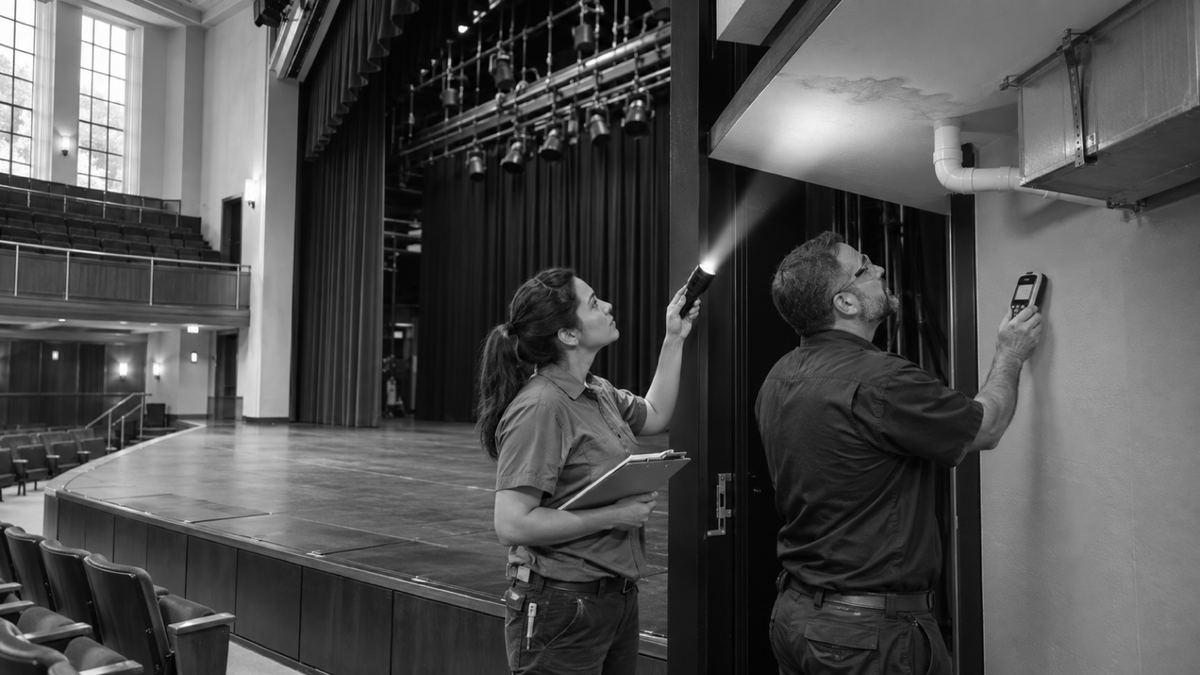
Performing arts venues need coordinated moisture checks because roofs, stages, curtains, storage rooms, orchestra pits, and HVAC systems share hidden pathways. A small leak above a stage wing can affect fabric, wood, electrical areas, costumes, and occupied spaces before the next performance reveals the full extent.
Why Performing Arts Venues Need a Specific Moisture Plan
Theaters, concert halls, rehearsal buildings, and community performance spaces combine tall rooms, complex roofs, variable occupancy, sensitive finishes, and equipment that may be difficult to move. The building can be quiet for days and then fill with people, lighting loads, open doors, and changing ventilation. Those shifts can affect temperature, humidity, condensation, and how quickly staff notice a problem.
Water can travel far from its source. Roof leaks may follow beams, rigging supports, conduit, or deck flutes before appearing near a stage. Condensate may move along piping or insulation. Plumbing from dressing rooms, restrooms, concessions, or fire-protection systems can affect ceilings and wall cavities below. Staff should document the observed location without assuming it identifies the source.
Materials also respond differently. Wood flooring can swell or cup. Acoustic panels, gypsum board, ceiling tile, carpet, fabric, paper scenery, costume stock, and instrument storage may retain moisture or show damage at different rates. Metal rigging and electrical systems add other safety concerns. Moisture response should coordinate qualified building, production, and safety personnel rather than treat every stain as a housekeeping task.
The goal is moisture control and timely evaluation. Staff should report water intrusion, condensation, musty odors, staining, damp materials, or unusual humidity. They should avoid diagnosing health effects, promising that a space is mold-free, or disturbing suspect materials beyond their training and authorization.
A Practical Inspection Routine
Begin with a venue map that names roof zones, drains, stage left and right areas, catwalks, orchestra pits, dressing rooms, costume storage, scenery storage, mechanical rooms, and air-handling equipment. Use consistent location names in work orders. A report that says backstage leak is less useful than one tied to a roof drain, structural bay, room, and elevation.
Inspect after heavy rain, snowmelt, roof work, HVAC shutdowns, plumbing events, sprinkler releases, or extended dark periods. Also check before a major production moves in and after it moves out. Temporary scenery, drapes, cable ramps, and stored cases can hide floor or wall conditions that routine cleaning does not reveal.
Review roofs and drainage from authorized access points. Look for blocked drains, damaged flashing, open penetrations, displaced materials, ponding, and signs of overflow. Roof work requires appropriate training and fall protection. Staff who are not authorized for roof access can still document indoor symptoms and route the inspection to qualified personnel.
Check HVAC and condensate systems. Review drain pans, traps, pumps, insulation, filters, access panels, and control trends where applicable. Supply air directed at a cold surface can contribute to condensation under certain conditions. A failed fan or disabled schedule can change humidity during a dark week. Record temperature and relative humidity with location and time when those readings support the investigation.
Inspect low and concealed areas that can be overlooked. Orchestra pits, under-stage voids, trap rooms, storage beneath seating, exterior-wall corners, and spaces behind curtains may have limited airflow. Use safe access and adequate lighting. Do not enter a confined space or open energized equipment unless a separate qualified procedure applies.
When moisture is found, record the date, exact location, recent weather or event, visible water, odor, affected materials, dimensions, photographs, and immediate controls. Identify and stop the source when authorized, protect people and contents, and arrange qualified evaluation where the source, extent, electrical involvement, or material condition exceeds staff capability.
Drying should match the material and situation. Moving air may help some clean-water drying tasks, but it can also spread contaminants or disrupt occupied areas. Removing a ceiling tile may expose overhead hazards. Wet fabrics, costumes, instruments, scenery, and archives may need specialist handling. The plan should define escalation contacts before an event occurs.
Verify before closing the work order. Confirm that the source repair holds, affected materials are dry or otherwise addressed, nearby areas were checked, temporary equipment is removed safely, and production staff receive an update. Repeated staining or odor should reopen the investigation rather than be covered with paint.
Common Mistakes and Misconceptions
A common mistake is checking only the audience-facing room. Moisture may originate above the stage, behind acoustic finishes, in a mechanical chase, or under stored production materials. A complete review follows credible water paths while respecting access limits.
Another mistake is assuming a dark venue is stable. HVAC schedules may be reduced, doors may remain closed, and leaks may go unreported between events. Planned checks during unoccupied periods can catch changes before rehearsals and performances resume.
Odor and appearance do not establish species, concentration, exposure, or health effect. Consumer sampling does not replace source control and professional evaluation. There are no federal mold exposure thresholds that certify a venue as safe or unsafe. Health concerns should be directed to qualified healthcare professionals, and state or local requirements should be reviewed for regulated work.
Painting a stain, spraying a product, or replacing one ceiling tile does not correct a continuing moisture source. A repair ticket should connect source control, material evaluation, drying, and verification. Cosmetic work should wait until the team has reasonable evidence that the condition is resolved.
Venue teams should not let production schedules override safety boundaries. Staff should not climb rigging, enter pits, open electrical equipment, or disturb suspect material without training and authorization. A delayed rehearsal is inconvenient, but an unsafe shortcut can expand the incident.
How Training Helps
Training gives facility managers, custodians, stage technicians, production managers, HVAC staff, and contractors a shared reporting process. Each role should know what to observe, what immediate actions are allowed, how to protect sensitive contents, where to record findings, and when to call qualified support.
The Mold Prevention, Moisture Control, and Remediation course on moldtraining.us is a relevant option for property and maintenance teams building this foundation. It can support awareness of moisture sources, prevention, documentation, and response principles. Employers should pair course content with the venue map, roof and HVAC procedures, production schedule, emergency contacts, personal protective equipment rules, and contractor requirements.
Courses provide certificates of completion, but a certificate does not guarantee licensure or authorize work reserved by a state or locality for licensed or otherwise qualified professionals. Requirements vary. Employers and individuals should check the rules where the venue is located and assign work based on training, experience, authority, and the condition being addressed.
A tabletop exercise can make the training practical. Use a scenario involving a roof leak before opening night, condensation in a costume room, or water in an orchestra pit after a plumbing event. Ask participants to document the condition, protect people and contents, identify access limits, notify the right roles, plan follow-up, and define closure evidence.
Frequently Asked Questions
Should staff cancel a performance whenever they find a water stain?
Not automatically. The response depends on active water, affected materials, electrical or structural concerns, location, extent, and whether qualified personnel can evaluate and control the condition. Staff should follow the venue's escalation process and avoid making unsupported safety assurances.
Can a moisture meter prove that a wall or stage is dry?
A meter can support an evaluation when a trained user understands the material, instrument, reference readings, and limitations. One number without location, depth, material context, and comparison data may be misleading. Use readings with visual inspection and source information.
Are curtains and costumes handled the same way as drywall?
No. Fabrics, wood, paper, acoustic products, and gypsum materials have different construction, value, cleaning limits, and drying needs. Valuable or specialized items may require conservation, textile, or other qualified support. The response plan should identify those contacts in advance.
Does a musty odor confirm mold?
No. An odor is a useful observation that should be documented and investigated, but it does not identify a species, amount, source, or health effect. Focus on finding moisture conditions and obtaining qualified evaluation when needed.
Should the HVAC system be turned off during every moisture event?
There is no universal answer. The decision depends on the source, affected area, contamination concern, equipment condition, occupancy, and how air movement may affect drying or distribution. Qualified building or HVAC personnel should make the decision using the venue's response plan.
When should outside help be called?
Outside support may be appropriate when moisture is extensive, the source is unclear, water affects electrical or structural systems, valuable materials are involved, suspect growth is widespread, occupants report health concerns, or state or local rules require qualified or licensed services.
Conclusion
Performing arts venues can prevent small moisture problems from becoming production emergencies by mapping vulnerable areas, checking after triggering events, documenting observations, and verifying repairs. The strongest process connects facility knowledge with production schedules and clear access limits.
Training can help staff recognize moisture conditions and communicate consistently, but it does not replace qualified evaluation or local requirements. A short review of the venue map, escalation contacts, and inspection schedule before the next major production is a practical place to begin.
Sources
United States Environmental Protection Agency, Mold Course Chapter 1 https://www.epa.gov/mold/mold-course-chapter-1
United States Environmental Protection Agency, Mold Remediation in Schools and Commercial Buildings Guide https://www.epa.gov/mold/mold-remediation-schools-and-commercial-buildings-guide
Centers for Disease Control and Prevention, Mold https://www.cdc.gov/mold-health/about/index.html