
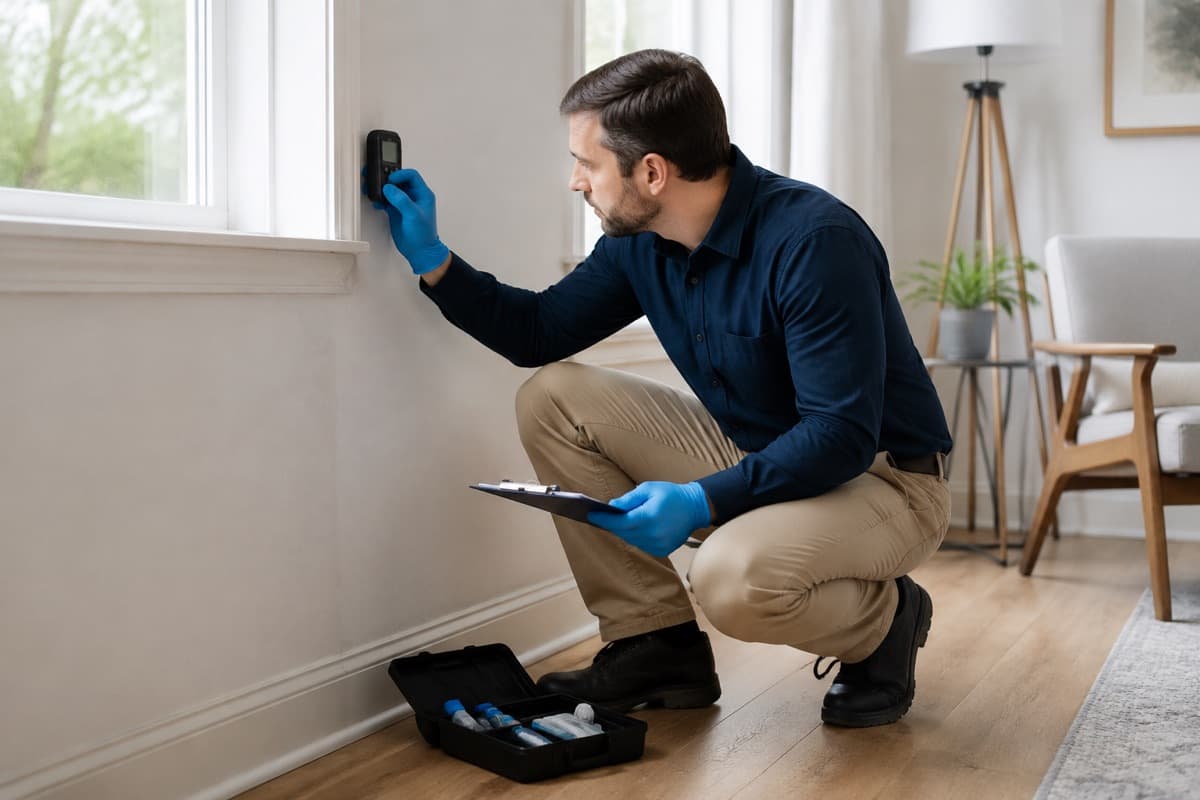
If you are a home inspector, remediation contractor, environmental consultant, or real estate professional thinking about adding mold-related services, the first question is how to inspect, document, sample, and report on mold concerns in a way clients can understand.
The IAC2 Mold Inspection Standards of Practice give many inspectors a practical framework for that work. They describe what a mold inspection is, what a complete or limited inspection should include, when sampling may be part of the assignment, and what should be reported. Learning the standards affects how you scope jobs, communicate limitations, avoid overpromising, and produce reports that support practical next steps.
This article explains what the IAC2 mold inspection standards cover, where training fits, and what new inspectors should understand before offering mold services.
What the IAC2 Mold Inspection Standards Are
IAC2, the International Association of Certified Indoor Air Consultants, publishes Mold Inspection Standards of Practice that outline standardized procedures for mold inspections. The standards distinguish between a complete mold inspection and a limited mold inspection.
A complete mold inspection is broader. Under the IAC2 framework, it generally involves a non-invasive visual examination of readily accessible systems and components, moisture, temperature, and humidity measurements, and mold samples according to the sampling procedures. The inspector reports moisture intrusion, water damage, musty odors, apparent mold growth, conditions conducive to mold growth, laboratory results for samples taken, and areas or components that were not inspected.
A limited mold inspection is narrower. It focuses on a specific room or area, such as a bathroom leak, a wall cavity near plumbing, or a visible stain around a window. The limited scope must be clearly described so the client does not confuse it with a whole-building inspection.
That distinction matters because mold inspection work can quickly become vague if the scope is not written down. Training should help inspectors understand what to inspect and how to define the assignment.
Why Scope Is One of the Most Important Skills
Many mold inspection problems start before the inspector enters the building. A client may ask, "Is there mold in this house?" or "Can you clear this property?" Those questions are broader than most inspection assignments can responsibly answer.
The IAC2 standards emphasize that a mold inspection is valid for the date of the inspection and does not predict future mold growth. Conditions that support mold growth can change when a leak begins, humidity rises, HVAC operation changes, or materials remain wet after a maintenance issue. A report can document what was observed and sampled during the assignment, but it should not become a warranty, guarantee, or insurance policy.
For inspectors, this means the scope needs to be practical and clear. What areas are included? Was the inspection complete or limited? Were there inaccessible spaces, active hazards, or client-imposed limitations? Were samples taken, and if so, what type?
Good mold inspection training should spend time on these boundaries. A well-scoped inspection keeps the client, inspector, and any follow-up contractor aligned.
Moisture Comes Before Mold Conclusions
EPA guidance consistently points back to moisture control as the central mold prevention strategy. Mold spores are common indoors and outdoors, and EPA notes that mold growth indoors can be controlled by controlling moisture. For an inspector, that means the investigation should ask why conditions might support growth.
Common inspection focus areas include roof leaks, window and wall penetrations, plumbing leaks, crawlspaces, basements, HVAC systems, condensation, poor ventilation, flooding history, and high indoor humidity. Moisture, humidity, and temperature measurements connect visual observations to building conditions.
This is where mold inspection becomes a building-science conversation. A stain below an air handler, recurring growth near exterior walls, or elevated moisture around a baseboard can point to different causes. The inspector's role is to document conditions and explain what the findings suggest within the inspection scope.
Sampling Is a Tool, Not the Whole Inspection
Mold sampling can be useful, but it is not a substitute for a visual inspection, moisture evaluation, or clear reporting. The IAC2 standards include outdoor and indoor air sampling, surface sampling, and guidance on when and where samples may be taken.
New inspectors sometimes assume that sampling is what makes an inspection credible. In reality, samples need to be collected with a defensible method, documented carefully, submitted to an appropriate laboratory, and interpreted in context. A sample result without clear site observations can create confusion instead of clarity.
Inspectors should also be careful with language around airborne mold levels. EPA, OSHA, and CDC do not set a single federal airborne mold threshold that determines whether an occupied building is safe or unsafe. Sampling can still have value, but inspectors should not present lab numbers as if a federal pass/fail limit exists.
Training should help inspectors understand when sampling supports the assignment, when visual and moisture findings may be enough to recommend correction, and how to report lab results without exaggerating what they prove.
What a Defensible Mold Inspection Report Should Include
A mold inspection report should help the client understand the assignment, observations, limitations, sampling performed, and next practical steps. A strong report commonly includes the property information, inspection date, scope of work, areas inspected, moisture and humidity readings, visible observations, photos, sampling locations, laboratory results, limitations, and recommendations for further evaluation or remediation when appropriate.
The report should separate observed facts from interpretation. For example, "elevated moisture was recorded at the baseboard below the living room window" is different from "the window is defective" unless the inspector has enough evidence to make that conclusion. Reports should also make clear when the inspector is not performing remediation.
Common Mistakes and Misconceptions
One common mistake is treating a mold inspection as the same thing as a home inspection. IAC2 distinguishes mold inspection from a general property inspection and from a comprehensive indoor air quality inspection. A mold inspector may look at building systems because they relate to moisture and mold conditions, but the assignment is not the same as inspecting every system for all possible defects.
Another misconception is that every job requires air sampling. Some conditions are obvious enough that the priority is moisture correction and cleanup rather than more data. Other situations may benefit from sampling, especially when there are conflicting observations, occupant concerns, post-remediation questions, or a need to document conditions at a point in time.
A third mistake is promising certification outcomes that a training course alone cannot guarantee. EPA does not certify mold inspectors or mold remediation firms, and OSHA does not issue a mold-specific inspector certification. A course can provide training and a certificate of completion, but inspectors should verify any separate state, local, employer, insurance, or association requirements that apply to their work.
Finally, some new inspectors underestimate documentation. Photos, locations, readings, sample IDs, limitations, and client communications are part of the inspection product.
How Training Supports Better Mold Inspection Work
Mold inspection training should help professionals connect standards, field observations, sampling decisions, and report writing.
For a home inspector adding mold services, training can clarify the difference between a general property inspection and a mold-focused inspection. For a remediation contractor, it can support better pre-remediation assessment and communication with clients. For an environmental consultant or real estate professional, it can create a common vocabulary around moisture, sampling, limitations, and documentation.
The Mold Inspector Certification Training from moldtraining.us is a 6-hour, self-paced online course aligned with the IAC2 Mold Inspection Standards of Practice. It covers mold biology, inspection methodology, sampling procedures, lab-result interpretation, and report writing, and it provides a certificate of completion after the final exam. It is designed for aspiring mold inspectors, home inspectors, remediation professionals, environmental consultants, and real estate professionals who need a structured introduction to mold inspection practice.
As with any training, it should be viewed as professional development rather than a guarantee of third-party licensure. Inspectors should verify local and state rules, insurance requirements, and any association credentialing requirements before advertising services.
Choose Standards-Aligned Mold Inspector Training
If your goal is to offer mold inspection services with a clearer process, the Mold Inspector Certification Training at moldtraining.us is the most relevant course. It is built around inspection concepts, IAC2-aligned standards, sampling, interpretation, and reporting, rather than general awareness alone. Property teams that only need basic awareness or tenant-response workflows may be better served by the Mold Prevention & Remediation Awareness Training or Property Management Mold Training.
FAQ
What does IAC2 stand for?
IAC2 stands for the International Association of Certified Indoor Air Consultants. It publishes standards and resources used by indoor air quality and mold inspection professionals.
Are the IAC2 Mold Inspection Standards only for homes?
The IAC2 Mold Inspection Standards of Practice describe residential buildings with four or fewer dwelling units. Inspectors working in commercial, multifamily, school, or industrial settings should verify which standards, contracts, client requirements, and local rules apply.
Does EPA certify mold inspectors?
No. EPA provides mold and moisture guidance, but it does not certify mold inspectors or mold remediation firms. Be cautious with any marketing claim that implies EPA certification for mold inspection work.
Does OSHA set an airborne mold exposure limit?
OSHA provides workplace mold guidance and worker-safety resources, but there is no single OSHA airborne mold threshold that functions as a pass/fail limit for occupied buildings. Inspectors should report sampling results carefully and in context.
Do all mold inspections require samples?
No. Sampling can be useful, but it should support the inspection objective. Visual observations, moisture readings, history, odors, and conditions conducive to growth are also important parts of the inspection.
Which moldtraining.us course fits someone who wants to become a mold inspector?
The Mold Inspector Certification Training is the best fit for aspiring mold inspectors, home inspectors adding mold services, remediation contractors, environmental consultants, and real estate professionals who need standards-aligned inspection training and a certificate of completion.
Conclusion
The IAC2 mold inspection standards give new and practicing inspectors a practical structure for scoping, inspecting, sampling, and reporting. They also reinforce a point every mold professional should understand: mold inspection is not a guess, a guarantee, or a lab report by itself. It is a documented process tied to visible conditions, moisture, limitations, and professional judgment.
For professionals adding mold inspection services, standards-aligned training can make that process clearer from the start. It helps you explain what you do, what you do not do, and how your findings should guide the next decision.
Sources
- International Association of Certified Indoor Air Consultants, Mold Inspection Standards of Practice
- U.S. Environmental Protection Agency, Mold Remediation in Schools and Commercial Buildings
- Occupational Safety and Health Administration, Mold
- Occupational Safety and Health Administration, A Brief Guide to Mold in the Workplace
- moldtraining.us, Mold Inspector Certification Training