
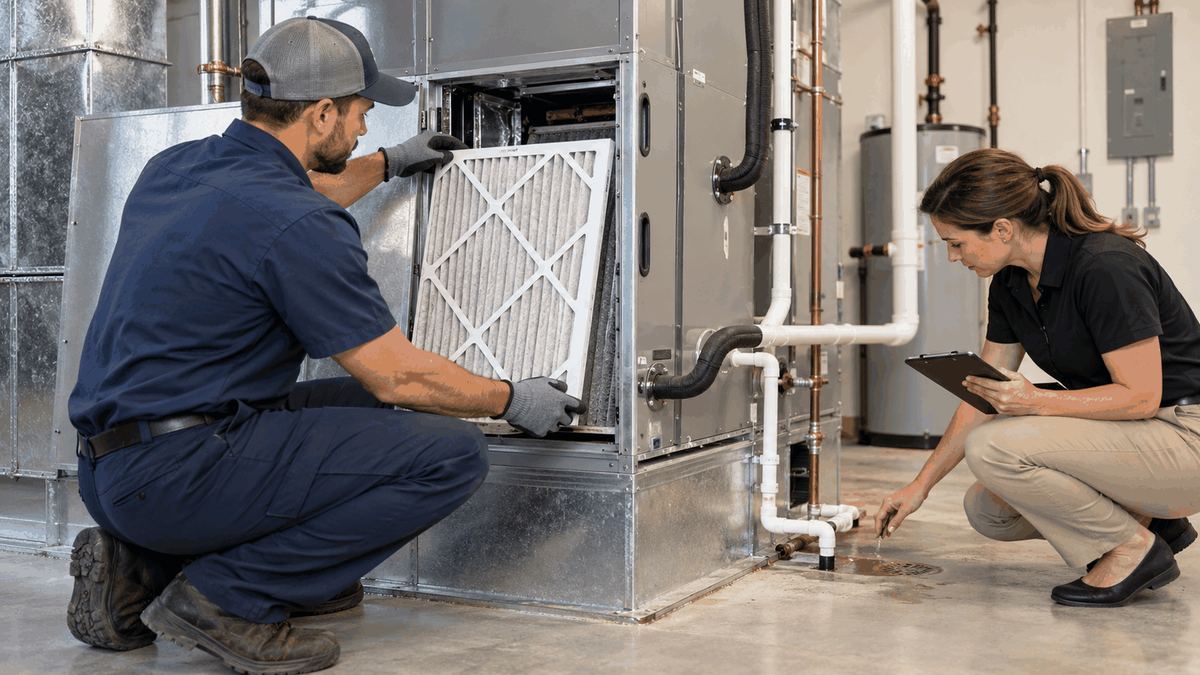
HVAC filter changes support mold prevention when teams log moisture, filter condition, airflow concerns, and follow-up work during each replacement.
Filters matter, but a new filter cannot correct a roof leak, plumbing failure, condensation problem, blocked drain pan, or wet insulation. Building teams need a simple workflow that uses each scheduled filter change as an opportunity to look for moisture and report conditions before they become a larger building problem. The workflow should fit the building, equipment, employer procedures, and state or local requirements.
This topic is especially important for property managers, maintenance workers, leasing teams, schools, offices, hotels, and commercial facilities. Staff may be the first people to notice a wet filter, staining near an air handler, unusual odor, damaged insulation, or a room that feels persistently humid. Training helps them recognize and document those observations without asking them to diagnose mold or perform work outside their role.
Why HVAC Documentation Supports Mold Prevention
EPA guidance identifies moisture control as central to mold prevention and recommends routine building and HVAC inspection and maintenance. HVAC equipment can create or reveal moisture through condensation, drain problems, humidifiers, roof leaks, exterior infiltration, or inadequate airflow. A filter change is therefore a useful checkpoint, but it is not proof that the system is clean or that a building has no mold concern.
Documentation turns an observation into a handoff. The record can identify the unit, room, date, filter size or type, filter condition, visible moisture, drain-pan condition, temperature or humidity reading when available, and the action taken. A manager can then assign a work order, contact an HVAC vendor, investigate a leak, or escalate a concern through the building's response process.
The record also helps separate routine maintenance from a building complaint. A filter with ordinary dust may need replacement. A wet filter, damaged filter, standing water, or recurring condensation may indicate a moisture source that needs prompt attention. A musty odor or visible growth may require a different assessment and work plan. Staff should document what they saw and avoid making unsupported conclusions from a single observation.
What Building Teams Should Record
Use a consistent checklist for each unit or air-handling area. The form can be paper, a work-order application, or a shared digital record, provided it is accessible and retained according to the employer's process.
- Identify the building, room, unit, equipment ID, date, time, and person completing the check.
- Record the old filter's condition, including wetness, unusual loading, damage, odor, or evidence that it was bypassed.
- Record the replacement filter information and whether it fit securely in the intended direction.
- Look for water in or around the drain pan, condensate line, coil area, humidifier, cabinet, nearby ceiling, and adjacent wall or floor.
- Note visible staining, damaged insulation, corrosion, dripping, condensation, or material that cannot be safely inspected.
- Record humidity or temperature readings when the team is trained, the instrument is suitable, and the measurement supports the building's process.
- Photograph the equipment and condition when safe and when a photograph will clarify the work order. Avoid including personal information or occupants when it is not needed.
- Describe the action taken, such as replacing the filter, clearing a permitted obstruction, isolating an area, reporting a leak, or calling a qualified vendor.
- Assign the next action, responsible person, and target date. Close the record only when the follow-up is documented.
The person changing a filter should not remove panels, enter restricted mechanical spaces, repair electrical systems, handle contaminated materials, or alter equipment settings without authorization and training. The checklist should make escalation easy. “Water present, supervisor notified, unit placed on work order” is more useful than a vague note that the filter was changed.
Use comparable descriptions across the property. Terms such as dry, damp, wet, damaged, heavily loaded, or inaccessible should have practical meaning for the team. If the building uses a humidity target or response threshold, follow the employer's procedure and avoid presenting a general number as a universal mold standard. Federal agencies have not established a federal airborne mold limit for building compliance, and state or local requirements may differ.
Common Mistakes and Misconceptions
The most common misconception is that filtration prevents mold by itself. Filters can capture particles, but mold growth is connected to moisture. A filter cannot dry wet insulation or fix a leak. Another mistake is choosing a higher-efficiency filter without confirming that the equipment can handle the resulting pressure drop. Equipment and manufacturer guidance should guide that decision.
Teams also sometimes treat a damp filter as a housekeeping issue. It may be a signal of condensation, drain failure, coil carryover, humidifier leakage, or another moisture problem. Replacing it without documenting the cause can allow the condition to repeat. The better response is to protect occupants and workers, report the condition, and follow the building's investigation and repair process.
Do not ask maintenance staff to confirm that a material is mold simply because it looks dark or smells musty. Visual observations are useful, but identification, sampling, remediation, and post-remediation decisions may require appropriately qualified professionals and state or local guidance. Training should define the boundary between awareness, documentation, maintenance, inspection, and remediation.
Avoid storing records only in a technician's personal phone. If a leak becomes a recurring complaint, the building needs a retrievable history that connects the first observation to later repairs. A simple asset ID and work-order number can prevent information from disappearing when staff change roles.
How Training Helps
Mold Prevention and Remediation Awareness Training can help general staff, maintenance workers, leasing teams, and employers build a shared understanding of moisture, common building conditions, reporting, and safe boundaries. It can support a consistent response without suggesting that every employee should inspect or remediate mold.
Property Management Mold Training is a natural fit when property teams handle tenant complaints, moisture observations, documentation, vendor coordination, and communication. The course can help managers connect filter-change records with work orders, complaint history, building areas, and follow-up decisions. That makes the process more useful than a checklist completed only for maintenance compliance.
Mold Inspector Certification Training may fit professionals who intend to provide inspection services and need a more advanced, standards-aligned path. It is different from awareness training for building staff. A certificate of completion does not guarantee a third-party license, and employers and professionals should verify state and local requirements before offering services.
The most useful training is paired with a site-specific workflow. Walk through one mechanical room, identify safe observation points, review the filter-change form, practice a moisture escalation, and clarify who contacts the vendor. Include English and Spanish access when that reflects the workforce. The result should be a team that recognizes a condition, records it accurately, and gets the right person involved.
Frequently Asked Questions
Does changing an HVAC filter prevent mold?
No. A clean, correctly installed filter can support equipment operation and particle control, but mold prevention depends on controlling moisture. Leaks, condensation, humidity, wet materials, and drainage problems still need to be identified and addressed through the building's maintenance process.
What should staff do if a filter is wet?
Follow the employer's procedure, document the equipment and visible condition, protect the area as directed, notify the responsible supervisor, and request investigation of the moisture source. Staff should not open equipment or handle suspect materials beyond their training and authorization.
Should every filter change include a humidity reading?
Not necessarily. A humidity reading can be useful when the team has suitable equipment and a defined process, but the reading should be interpreted with the building's design, season, location, and procedures. A number without context should not be treated as a diagnosis.
Does a musty odor prove that mold is present?
No. An odor can prompt documentation and investigation, but it does not identify the source or establish the extent of a condition. Building teams should record where and when the odor was noticed and follow the employer's escalation process.
Is moldtraining.us training a government certification?
No. moldtraining.us provides online courses and certificates of completion, including standards-aligned options. EPA, OSHA, and CDC do not certify these courses or set a universal federal airborne mold threshold. Check applicable state and local requirements for inspection or remediation work.
Conclusion
Treat each HVAC filter change as a small moisture-control checkpoint. Document what the team can safely observe, connect findings to a work order, and train staff to recognize when a routine task needs a supervisor, HVAC professional, or qualified mold specialist.