
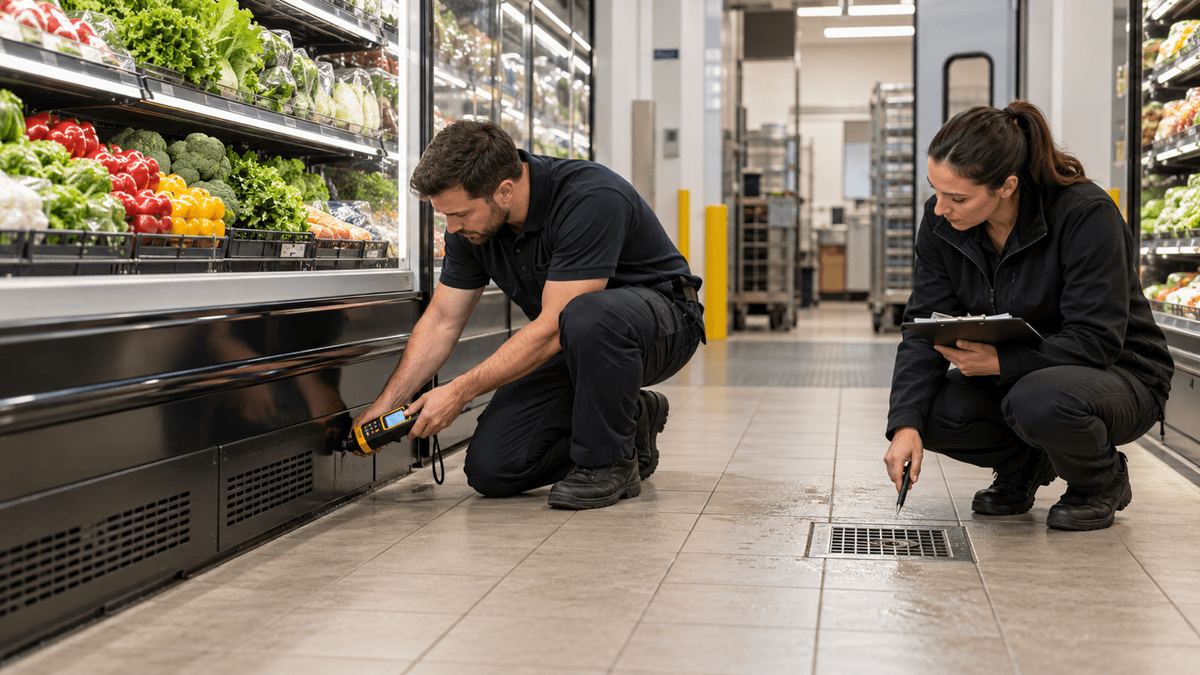
Grocery stores need a moisture routine that connects refrigeration, produce, drains, receiving areas, and repairs before damp conditions spread.
Food retail buildings combine cold equipment, frequent cleaning, wet products, floor drains, exterior deliveries, and long operating hours. A small condensate problem can affect case bases, walls, flooring, stock, and neighboring spaces before it becomes obvious. Property and maintenance teams need a repeatable way to spot moisture, protect people and products, document conditions, and coordinate repairs without diagnosing mold by appearance alone.
Why Grocery Stores Need a Specific Moisture Routine
Refrigerated cases operate below the temperature of surrounding air. When warm humid air reaches cold surfaces, condensation can form on doors, frames, pipes, panels, and nearby finishes. Defrost cycles and condensate systems add water that should drain predictably. A blocked line, failed pan heater, damaged gasket, misaligned door, or changed airflow can create recurring wetting.
Produce departments introduce another moisture pattern. Misters, wet displays, ice, wash areas, trimming stations, and frequent floor cleaning can leave water near porous wall bases, grout, shelving, and floor transitions. The visible puddle may be removed while moisture remains behind a case, below a mat, inside a wall cavity, or under damaged flooring.
Receiving areas face exterior water, temperature swings, damaged packaging, pallet debris, and open doors. Rain can enter at dock seals or thresholds, and humid outdoor air can condense on cool surfaces. Roof drains, overhead plumbing, sprinkler lines, and refrigeration piping may pass above stored goods. Staff should notice both the source and the materials that were affected.
The store schedule can hide slow problems. Overnight stocking, early cleaning, defrost cycles, and daytime customer traffic may expose different conditions. A morning walk may miss water that appears in the afternoon, while a daytime inspection may not see what happens during cleaning. Trend-based checks across shifts are more useful than a single annual inspection.
Build Checks Around Store Zones
Refrigerated and frozen cases
Inspect case doors, gaskets, frames, drain pans, condensate lines, pipe insulation, bases, kick plates, and adjacent walls and floors. Look for recurring droplets, frost in unexpected locations, staining, swollen materials, loose flooring, musty odor, or repeated towels and cones. Ask whether the condition follows a defrost cycle, weather change, service call, or door problem.
Produce, floral, seafood, and prepared-food areas
Map misters, sinks, ice, wash stations, floor drains, hose connections, and cleaning routes. Check splash zones, wall bases, shelving feet, mats, and penetrations. Water on a cleanable floor may still migrate into joints or damaged finishes. A drain that works slowly can leave repeated wetting even when it does not fully overflow.
Receiving, storage, and back-of-house spaces
Inspect dock doors, seals, levelers, thresholds, overhead doors, roof transitions, plumbing, sprinkler piping, coolers, freezers, cardboard storage, and exterior drainage. Keep susceptible stock and packaging away from known wet areas. Document water-damaged ceiling tiles, wallboard, insulation, wood, or cardboard and follow store procedures for product disposition and building response.
Sales floors, entrances, roofs, and mechanical rooms
Entry doors can bring in rain and humid air, while damaged mats or flooring can hold moisture. Check vestibules, windows, skylights, roof drains, ceiling areas, plumbing chases, janitor closets, water heaters, HVAC equipment, and condensate drains. A stain above one aisle may originate from a roof or pipe some distance away.
Responding to a Moisture Finding
First address safety. Control slips, electrical hazards, falling materials, contaminated water, unstable shelving, and damaged equipment. Protect customers and employees without creating a new obstruction. Stop the water source if staff can do so safely and within their authority, then notify the responsible manager and service provider.
Document the location, discovery time, shift, equipment or building area, apparent source, material affected, visible extent, odor, photographs, weather where relevant, and immediate controls. Use a stable location or equipment identifier. Descriptions such as water by frozen case are less useful than case FZ-12, east base, extending two floor tiles toward aisle.
EPA guidance emphasizes drying wet materials promptly, generally within 24 to 48 hours, and correcting the moisture source. That interval is a response goal, not a guarantee that mold will not grow or that every material can be saved. Porous materials, contaminated water, concealed cavities, or extensive damage may require qualified evaluation and removal.
Separate equipment repair from building recovery. Clearing a condensate line may stop new water, but wet wallboard, flooring, insulation, wood, or stored materials may still need drying, cleaning, replacement, or professional assessment. The work order should not close until the source and affected area have both been addressed.
Verify the result. Reinspect after the next defrost cycle, cleaning period, rain, or high-humidity condition that previously triggered the problem. Record whether the area remained dry, whether finishes stayed intact, and whether odor or staining returned. Repeated problems should be reviewed for design, drainage, insulation, airflow, maintenance, or operational causes.
Common Mistakes and Misconceptions
One mistake is treating every puddle as a housekeeping issue. Cleaning may remove the immediate slip hazard while a drain, gasket, pipe, pan, roof, or door problem continues. Repeated water in the same place should become a facilities investigation.
Another mistake is assuming cold equipment always explains condensation. Temperature contributes, but damaged insulation, air leaks, high humidity, blocked airflow, control problems, and door practices may also matter. Qualified refrigeration and building personnel should evaluate the cause.
Do not paint, caulk, or cover water-damaged materials before the source and material condition are addressed. Cosmetic work can hide evidence and trap moisture. EPA and CDC guidance emphasizes correcting moisture problems and drying or removing affected materials as appropriate.
Do not identify a mold type by color, odor, or a photograph. Staff should report observations and moisture conditions. Sampling is not a substitute for finding and correcting water, and professional evaluation may be appropriate when the extent or cause is uncertain.
Do not assume a completed refrigeration ticket closes the building issue. Link mechanical repair, material response, product or area controls, drying verification, and follow-up. Recurrent tickets can reveal a broader pattern that individual vendors do not see.
How Training Helps
Mold and moisture awareness training gives cashiers, stockers, department leads, cleaners, maintenance staff, and managers a shared reporting language. Employees can learn which observations matter, how to control immediate hazards, what not to disturb, and whom to contact. They do not need to become mold inspectors to report a recurring condensate line or damaged wall base well.
Facilities training can go deeper into moisture mapping, photo standards, work-order links, meter limitations, material response, vendor coordination, and post-repair checks. Scenario practice should reflect the store: a freezer case that wets the floor after defrost, produce mist reaching a wall base, rain at the loading dock, or a roof leak above cardboard stock.
The Property Management Mold Training course at moldtraining.us is a natural fit for managers and maintenance teams responsible for building moisture and documentation. The Mold Awareness Training course can support general staff who need to recognize and report conditions. Courses provide certificates of completion, but they do not guarantee licensure or authorize regulated work. Employers and participants should review current state and local requirements.
Training works best when the store adds its own procedures. Include emergency contacts, department responsibilities, food and product controls, approved cleaning limits, equipment identifiers, documentation systems, vendor contacts, and decision points for professional evaluation. Refresh the procedure after a significant event or a repair that does not hold.
Frequently Asked Questions
Should every refrigerated case have a moisture check?
The store should use a risk-based routine that covers refrigerated and frozen equipment, especially cases with past leaks, condensate systems, damaged gaskets, or adjacent porous finishes. The frequency should match equipment behavior, service history, humidity, and store procedures. A quick observation can be built into opening or closing checks, with a more detailed facilities review on a defined schedule.
Is condensation always a sign of mold?
No. Condensation is water forming on a cool surface, and it does not by itself prove mold growth. It is still a moisture condition that should be corrected when it wets materials or creates recurring dampness. Document where and when it occurs, then evaluate humidity, temperature, airflow, seals, insulation, drainage, and equipment operation.
Can staff use a moisture meter behind grocery cases?
Only when they are trained, authorized, and can access the area safely. Moisture meters have material and interpretation limits, and equipment areas may contain electrical, refrigeration, sharp-edge, lifting, or product hazards. A reading supports an investigation but does not identify mold or replace source control and professional judgment.
What should happen after a condensate drain is cleared?
Confirm that new water has stopped, inspect nearby building materials and stock, dry or remove affected materials as appropriate, document the repair, and reinspect under the conditions that previously caused the leak. If water reached concealed spaces or porous finishes, qualified evaluation may be needed.
Does a mold training certificate make someone licensed?
No. A course certificate documents completion of that training. It does not guarantee licensure, replace state or local credentials, or authorize work that a jurisdiction regulates. Employers and workers should check current state and local requirements and define duties within the person's training and authority.
Should a store wait for test results before fixing a leak?
No. Correcting the moisture source and responding to wet materials should not be delayed simply to obtain routine mold sampling. Testing may be useful in selected professional investigations, but it does not replace prompt water control, safe documentation, and an appropriate material response.
A Practical Next Step
Walk one refrigerated aisle, one wet department, the receiving dock, and one back-of-house storage area with maintenance and an operations manager. Mark every water source, drain, cold surface, porous finish, prior leak, and recurring work order. Choose stable identifiers and assign routine checks by role and shift.
Then test the reporting chain with one realistic scenario. Confirm that the employee controls immediate hazards, records useful facts, reaches the right manager, creates linked equipment and building work, and triggers a follow-up visit. If the team needs a shared foundation, review the Property Management Mold Training and Mold Awareness Training options at moldtraining.us as part of the store's broader moisture-control program.
Conclusion
Grocery-store mold prevention is practical moisture management. The strongest routine connects cold equipment, wet departments, drains, receiving, roofs, cleaning, documentation, repair, material response, and verification. Training helps people notice the right conditions and hand them to the right role before repeated dampness becomes a larger indoor air quality and property problem.
Sources
- United States Environmental Protection Agency, The Key to Mold Control Is Moisture Control
- United States Environmental Protection Agency, Biological Contaminants and Indoor Air Quality
- Centers for Disease Control and Prevention, Mold, Testing, and Remediation
- Centers for Disease Control and Prevention, Mold