
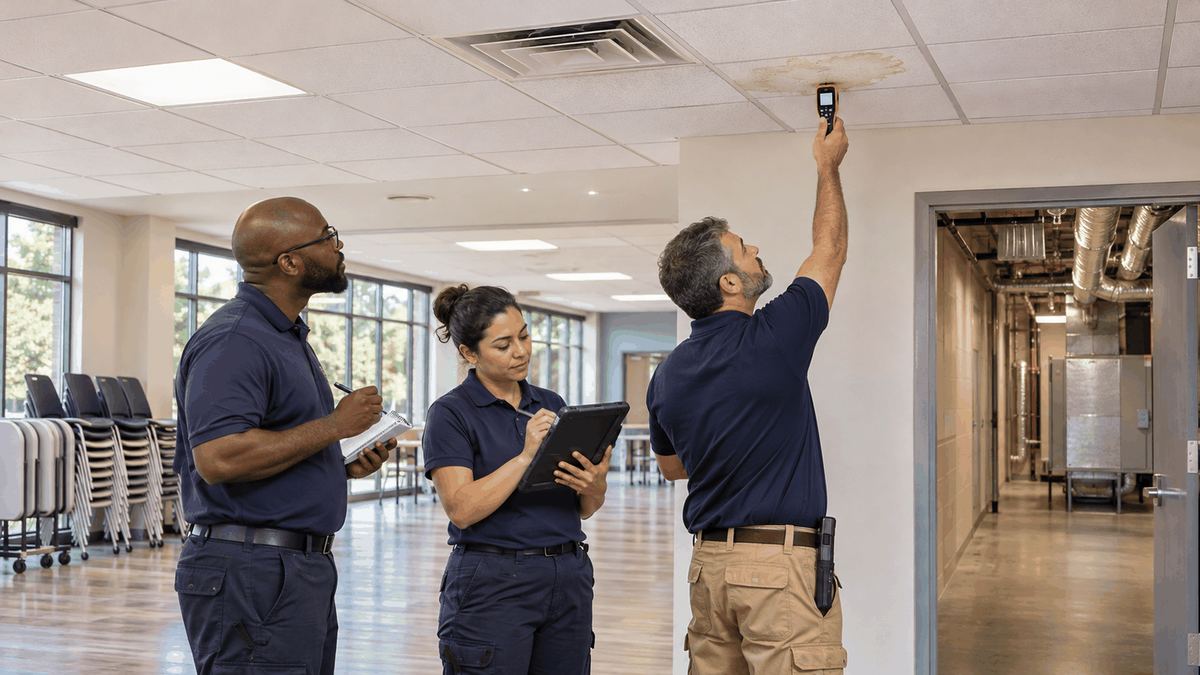
Community centers need a clear moisture response because busy rooms, varied schedules, roof systems, and HVAC changes can hide small leaks until damage spreads.
A community center may contain meeting rooms, kitchens, gyms, restrooms, storage areas, offices, and mechanical spaces under one roof. Those spaces can experience very different temperature, humidity, and occupancy patterns during the same day. A roof leak might appear only during wind-driven rain. A crowded event may create condensation near diffusers or windows. A plumbing problem may be reported after staff have changed shifts. Property and maintenance teams need a common way to notice moisture, document what they see, protect occupants from affected areas, and coordinate repair and drying without making conclusions beyond their training.
Mold prevention begins with moisture control. Mold can grow on many building materials when moisture remains available, and there is no practical inspection routine that replaces fixing the source. Staff do not need to identify a mold species to report water staining, damp materials, musty odors, condensation, or a recurring leak. Their job is to recognize conditions early, follow the facility's response procedure, and provide useful information to the person responsible for evaluation and corrective work.
Why Community Centers Need a Site-Specific Routine
Community centers often operate beyond normal office hours. Volunteers, instructors, event renters, recreation staff, custodians, and maintenance personnel may each see the building at different times. A leak noticed after an evening program may not reach the day crew unless the reporting path is simple and available to everyone. The routine should explain what to report, whom to contact, what immediate actions are permitted, and how the report is handed off when the building changes shifts.
Multipurpose rooms create particular challenges because furniture, portable stages, stored supplies, wall padding, and temporary decorations can conceal damp surfaces. Rooms may be reset quickly between activities, allowing a ceiling stain or wet carpet edge to be overlooked. Staff should include moisture observations in event setup and closing checks, especially after severe weather, plumbing incidents, or HVAC interruptions. The goal is not a technical mold inspection. It is a repeatable screen for changes that deserve attention.
Roof and drainage conditions can affect locations far from the apparent entry point. Water may travel along deck flutes, beams, piping, or ceiling grids before it becomes visible. A stain should therefore be documented by exact room, ceiling grid or wall location, time, weather, and any change from earlier observations. Photographing the surrounding area as well as the close condition helps maintenance staff compare reports. Repainting a stain without confirming the moisture source can hide useful evidence and allow the underlying problem to continue.
HVAC schedules also matter. A building may be conditioned for a large event and then set back overnight or on weekends. Outdoor-air changes, clogged drain lines, wet insulation, poorly insulated surfaces, and temperature differences can contribute to condensation. Staff should report recurring moisture near diffusers, piping, windows, mechanical closets, and ceiling penetrations. HVAC operation should be evaluated by qualified personnel rather than adjusted randomly in response to a single humidity reading.
Moisture Checks by Area
In multipurpose rooms, begin with the ceiling perimeter, roof penetrations, exterior walls, windows, baseboards, carpet edges, and areas hidden by movable equipment. Look for discoloration, sagging materials, peeling finishes, dampness, or odors that differ from the room's normal condition. Check whether chairs, mats, boxes, or decorations are pressed against a cool exterior wall where airflow is limited. If staff use a moisture meter, the organization should train them on the tool's purpose and limits. A reading is one data point and should be interpreted with material type, location, and comparison readings.
Restrooms, locker areas, and kitchens need attention around supply lines, drains, fixtures, cabinets, wall penetrations, exhaust systems, and flooring transitions. Small leaks can wet concealed materials while the floor appears dry. Staff should document recurring caulk failure, loose fixtures, damaged grout, slow drains, or condensation rather than treating each symptom as an isolated housekeeping issue. Cleaning is important, but cleaning alone does not correct a plumbing leak or ventilation problem.
Storage rooms can amplify a minor incident because cardboard, paper, fabric, and pressed-wood products hold moisture and restrict airflow when packed tightly. Keep materials away from known leak points and provide enough access for inspection. After a water incident, staff should note which items were wet, when the water was discovered, and what actions were taken. Decisions about cleaning, drying, or discarding materials should follow the facility's plan and the advice of qualified professionals when needed.
Mechanical and roof-access areas should be inspected only by personnel authorized and trained for those locations. Relevant observations may include condensate at equipment, blocked drains, wet insulation, corrosion, water below roof openings, or evidence that a prior repair has not held. Roof work, electrical hazards, confined areas, and moving equipment require separate controls. Mold awareness training does not qualify someone to perform work outside that person's assigned duties.
Common Mistakes and Misconceptions
One misconception is that visible color identifies the type or health significance of mold. Appearance alone does not establish species or exposure. Staff should focus on the moisture source, affected materials, extent, and appropriate response. Another mistake is waiting for a laboratory result before stopping an active leak. Source control and prompt evaluation should follow the organization's procedures without requiring staff to diagnose the material.
Another mistake is treating a musty odor as a housekeeping problem. Odor can have several causes, but a recurring or localized change deserves documentation and follow-up. Teams also lose time when reports say only there is mold in the room. A better report identifies the exact location, what was observed, whether materials were wet, when it was found, relevant weather or building events, and who was notified.
It is also risky to assume that drying the visible surface means concealed materials are dry. Water may reach insulation, wall cavities, floor assemblies, or the space above a ceiling. The appropriate method for evaluating concealed moisture depends on the construction and incident. Staff should avoid destructive opening unless they are authorized, trained, and using the controls required for the work.
Finally, disinfectants, paint, or fragrance should not be used to substitute for source correction and appropriate cleaning or material decisions. Products have instructions and hazards, and some materials cannot be restored by surface treatment. The response plan should define when routine maintenance is appropriate and when the facility needs an experienced remediation, building, HVAC, roofing, or environmental professional.
How Training Helps
Training gives front-line staff a shared vocabulary and a consistent escalation path. Employees can learn the difference between observing a condition and diagnosing it, how to document time and location, which immediate steps are allowed, and how to protect an area until the responsible person responds. Supervisors can practice assigning ownership, tracking open items, and verifying that repair, drying, and communication steps are complete.
Scenario exercises are useful for community centers. A class discovers a wet ceiling tile after a storm. A weekend renter reports a musty odor in a storage room. Condensation appears near supply diffusers during a crowded event. A sink leak wets cabinet material before a holiday closure. Teams can walk through who receives the report, what the first authorized action is, whether the room needs to be restricted, what information is recorded, and how the next shift learns the status.
Mold Awareness Training from moldtraining.us can support employees who need foundational knowledge about moisture, mold, documentation, and prevention within their assigned roles. A course should be paired with site-specific procedures, building contacts, and hands-on orientation to the community center. The courses provide certificates of completion and do not guarantee licensure. Learners and employers should review state and local requirements for any license, registration, certification, or regulated mold work that may apply.
Frequently Asked Questions
Should staff test every stain for mold?
Not every moisture stain requires sampling. EPA guidance emphasizes moisture control, and visible conditions often call for correcting the water source and evaluating affected materials. Sampling may be appropriate in some circumstances, but staff should follow the facility's procedure and qualified advice rather than ordering tests automatically or interpreting results without the necessary expertise.
How quickly should wet materials be addressed?
Prompt action matters. EPA guidance commonly advises drying wet or damp materials within 24 to 48 hours when possible, while recognizing that the actual response depends on the material, water source, extent, safety conditions, and professional judgment. Staff should report the incident immediately and document when water exposure and response were discovered rather than assuming the clock began when maintenance arrived.
Can a community center stay open during moisture work?
That decision depends on the location, extent, affected materials, work methods, occupant needs, and hazards. Management may need input from maintenance, contractors, environmental or health professionals, and local authorities. Staff should not promise continued operation or closure based only on the presence of a stain. The response plan should identify who has decision authority.
Do humidity readings prove that mold is present?
No. Relative humidity is useful context, but it does not prove mold growth or identify moisture hidden inside an assembly. Readings vary with temperature, location, instrument, and time. Trained staff can use humidity trends alongside observations, HVAC information, and moisture measurements, while avoiding conclusions the data does not support.
When should an outside professional be called?
Professional help may be appropriate for large or recurring water events, extensive affected materials, suspected contamination from sewage or other hazardous sources, hidden conditions, HVAC involvement, structural concerns, occupant sensitivities, or work beyond staff training and equipment. The facility should set escalation criteria in advance and verify any credential requirements that apply locally.
Conclusion
Community centers can reduce confusion by making moisture response part of ordinary building operations. Routine observations, precise reports, clear handoffs, authorized immediate actions, and verified closure help teams act before a small leak becomes a larger building problem. Training supports that routine, but it works best when employees know the limits of their role and can reach qualified help quickly. A short review of multipurpose rooms, roof-related locations, HVAC areas, restrooms, and storage spaces is a practical place to begin.
Sources
U.S. Environmental Protection Agency, A Brief Guide to Mold, Moisture and Your Home - https://www.epa.gov/mold/brief-guide-mold-moisture-and-your-home
Centers for Disease Control and Prevention, About Mold and Your Health - https://www.cdc.gov/mold-health/about/