
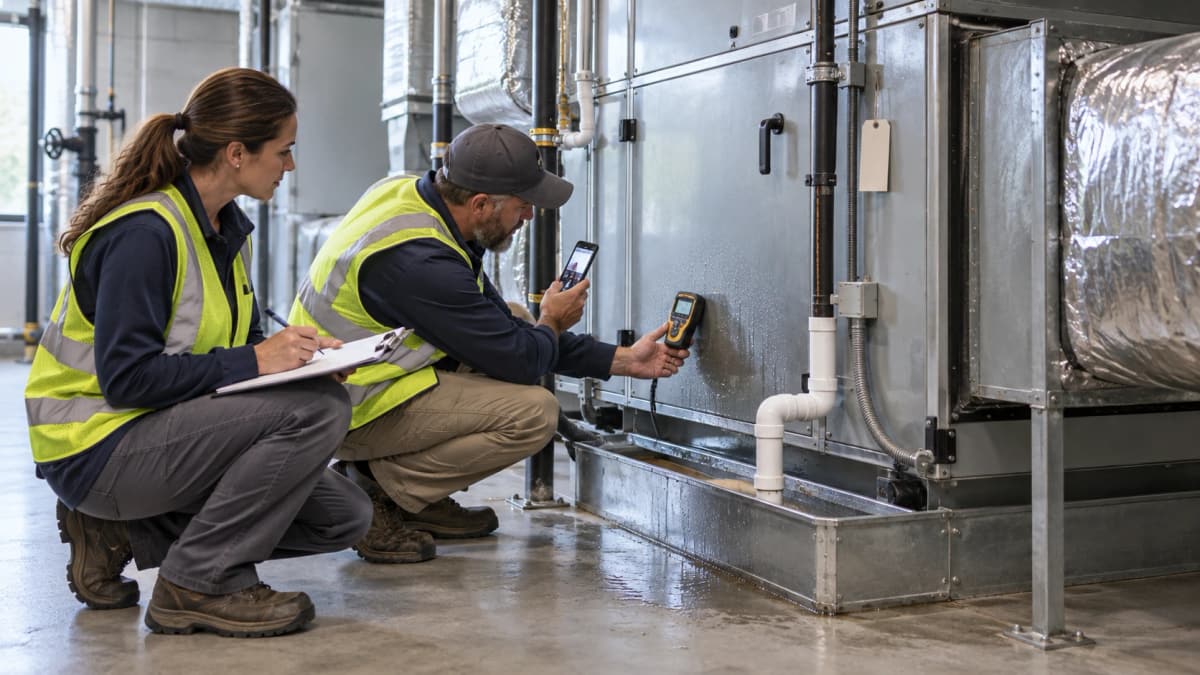
Building teams can reduce confusion after an HVAC moisture event by documenting the source, affected area, response steps, and follow-up before a mold complaint becomes a larger property-management issue.
Condensation, drain-pan overflow, roof leaks near equipment, humid outside air, and plumbing failures can all introduce moisture into a building. The first response is often handled by a maintenance worker, engineer, property manager, or vendor who must preserve information while controlling the source. A consistent workflow helps the team communicate with occupants, select the right specialist, and avoid unsupported conclusions about health, cause, or responsibility.
Documentation is not a substitute for inspection or remediation. It is a practical record of what the team knew, what it did, and what remained uncertain. The applicable state or local rules, lease terms, building procedures, and professional advice should guide the response.
Why HVAC Moisture Events Need a Consistent Workflow
HVAC systems can create moisture problems that are easy to miss at first. A blocked condensate drain may produce intermittent overflow. A cold supply duct in a humid ceiling cavity may condense. A failed control can leave an area warmer and more humid than expected. A filter change, equipment shutdown, or renovation can alter airflow and expose a previously hidden condition.
The visible spot is not always the source. Water may travel through ceiling tiles, insulation, wall cavities, or flooring before it becomes noticeable. That is why a team should document the equipment, nearby surfaces, timeline, and conditions rather than assuming that the first wet area explains the entire event.
Early records help building managers coordinate occupants and vendors. They can show when the complaint was received, whether the area was isolated, whether the HVAC system was shut down or adjusted, whether materials were dried or removed, and when the area was checked again. If a specialist becomes involved, the record gives that person a clearer starting point.
Mold can grow when moisture remains, but a damp surface does not automatically establish a mold problem. Teams should avoid diagnosing from appearance alone, using unsupported airborne-threshold claims, or promising that a cleaning step resolves every concern. The practical priority is to find and correct moisture, protect occupants and workers, and escalate when the condition is beyond the team’s training or authority.
What Building Teams Should Document
A simple incident record can support the response without turning maintenance staff into inspectors. Capture the date and time of the report, the person reporting it, the room or asset, the visible condition, the suspected source, and immediate controls. Photos should show context, not only a close-up. Include equipment tags, ceiling or wall locations, and any areas opened for inspection when appropriate.
Record HVAC information that may affect the event:
- Equipment serving the area and the operating mode when the issue was found.
- Condensate drain, pan, pump, trap, insulation, coil, damper, and filter observations.
- Recent alarms, shutdowns, service visits, filter changes, control changes, or construction work.
- Indoor temperature and relative humidity readings when taken with a suitable instrument.
- Evidence of active water, staining, condensation, damp materials, odor, or visible growth.
- Materials affected, approximate area, and whether the condition may extend behind finishes.
- Immediate steps such as stopping a leak, containing water, protecting contents, drying materials, or restricting access.
- Vendor contact, work order, repair performed, and the date of the follow-up check.
Measurements need context. A single humidity reading is a snapshot, not a complete building assessment. Note where and when it was taken, whether the space was occupied, and whether outdoor conditions or HVAC operation could influence it. Use instruments according to their instructions and do not present an approximate reading as a laboratory result.
The response record should distinguish observation from interpretation. “Brown discoloration on ceiling tile below supply duct” is an observation. “Mold caused by poor ventilation” is an interpretation that may require further evaluation. This distinction helps the team communicate accurately with tenants, employees, insurers, owners, and contractors.
How Property Managers and Maintenance Teams Should Respond
First, protect people and property from the active source. Address water safely, use appropriate personal protective equipment for the task, and avoid disturbing suspect materials beyond the team’s training and procedures. If electrical equipment, sewage, contaminated water, structural damage, or extensive wet materials are involved, escalate to qualified professionals.
Second, control the HVAC condition without creating a new hazard. A system may need service, isolation, cleaning, or adjustment by a qualified technician. Do not simply increase fan operation if it could spread moisture or disturb contaminated material. Coordinate the response with building operations and document who authorized the change.
Third, set a follow-up time. Materials that appear dry can retain moisture, and a repaired drain does not prove that concealed areas are dry. Recheck the equipment and affected area, compare photos and readings, and update the work order. If conditions recur, expand the evaluation rather than repeatedly treating the visible symptom.
Occupant communication should be factual and calm. Tell the person what was observed, what immediate action was taken, what remains under evaluation, and how to report continuing conditions. Do not promise a health outcome or imply that a federal agency has certified the building, inspection, or course. If a tenant raises a health concern, direct them to an appropriate healthcare professional and follow the property’s established escalation process.
Employers should train maintenance and leasing staff on boundaries. Awareness training can help staff recognize moisture indicators, protect themselves, document observations, and report concerns. Property management training can address tenant complaints, work orders, vendor coordination, communication, and prevention workflows. Staff who perform specialized inspection or remediation work may need additional education, equipment practice, supervision, and compliance with state or local requirements.
Common Mistakes and Misconceptions
One mistake is cleaning the visible area before correcting the moisture source. Another is removing materials without recording their condition or considering whether the disturbance is appropriate for the worker and the building procedure. Teams can also lose time when several staff members open separate work orders with different descriptions.
It is a misconception that every musty odor identifies mold or that every dark mark is mold. It is also a misconception that a short online course grants a government license or turns a general maintenance worker into a mold inspector. Courses may provide certificates of completion and standards-aligned education, while state and local requirements may apply to inspection, assessment, remediation, disclosure, or contracting.
Another error is using a single humidity target as a guarantee. Humidity, temperature, building materials, air movement, and moisture duration all matter. Prevention is stronger when teams monitor recurring problem areas, maintain equipment, respond to leaks quickly, and review patterns across work orders.
How Training Helps
Mold Prevention & Remediation Awareness Training can help general staff, maintenance workers, leasing teams, and employers build a shared vocabulary for moisture prevention, safe response, documentation, and escalation. It is a useful foundation for recognizing when an HVAC issue, leak, or humidity concern needs attention.
Property Management Mold Training is more directly suited to property teams handling tenant complaints, work orders, moisture events, vendor coordination, and communication. It can help managers create a repeatable response path without suggesting that every complaint can be resolved by staff alone.
Mold Inspector Certification Training is a different path for people who intend to develop inspection services, such as home inspectors, environmental consultants, remediation contractors, and real estate professionals. Learners should confirm state and local requirements and understand that an IAC2-aligned course and certificate of completion do not guarantee third-party licensure.
The best next step for many buildings is a short workflow exercise: choose a recent HVAC moisture event, compare the record with the questions above, and identify one missing field, one unclear responsibility, and one prevention action. moldtraining.us courses can support that conversation while the employer or property owner maintains responsibility for site procedures and qualified technical decisions.
Frequently Asked Questions
Should maintenance staff test for mold after every HVAC leak?
Not necessarily. The first priorities are to control the moisture source, document the condition, dry affected materials when appropriate, and determine whether the situation exceeds the team’s capability. Testing decisions should be based on the building’s procedures, the scope of the condition, professional judgment, and applicable state or local requirements.
Does a humidity reading prove that mold is present?
No. A humidity reading describes one condition at one location and time. It can help identify a prevention concern, but it does not identify mold, its source, or an occupant-health outcome. Use readings with observations, building history, and qualified evaluation when needed.
Which mold course fits a property management team?
Property Management Mold Training generally fits teams handling tenant complaints, moisture events, documentation, and vendor coordination. Awareness training may fit general staff who need recognition and prevention basics. The employer should map the course to actual duties and any state or local requirements.
Can an online course make someone a licensed mold inspector?
An online course can provide education and a certificate of completion, but it does not guarantee a government license or third-party credential. People offering inspection or remediation services should check the requirements where they work and obtain any additional experience, examination, or authorization that applies.
What should a manager do when moisture keeps returning?
Review the timeline, equipment operation, repairs, readings, affected materials, and prior vendor notes. Recurrent moisture may require a broader building investigation, HVAC service, envelope review, or other qualified evaluation. Repeating surface cleaning without addressing the source is unlikely to resolve the underlying problem.
Conclusion
Good HVAC moisture response is a building-management process: document the report, control the source, protect people and materials, communicate accurately, and follow up until the condition is understood. Training helps teams recognize their role and their limits, while qualified professionals and local requirements guide specialized decisions.